
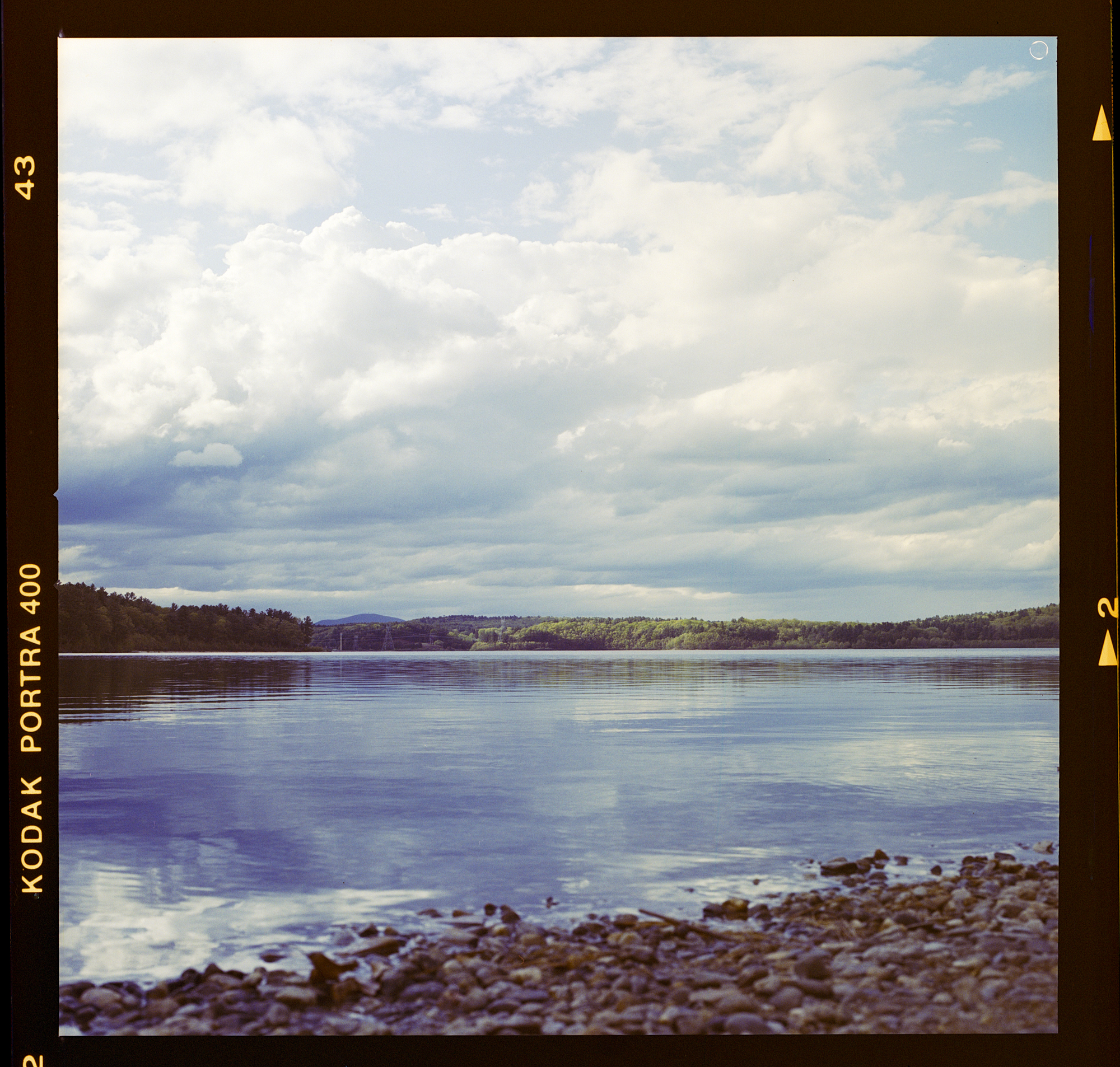
There’s something unmistakable about a well-exposed medium format negative. When you hold a 6×6 or 6×7 transparency up to the light, or pull a contact print from the wash, you’re looking at something digital simply cannot replicate. It’s not nostalgia talking—there are real, measurable reasons why medium format film produces images with a distinct aesthetic superiority.
Let’s break down why film continues to captivate photographers, and why medium format takes those advantages even further.
The Film Advantage: Why Analog Still Wins
Highlight Rolloff and Tonal Transitions
Perhaps the most significant difference between film and digital lies in how each handles highlights. Digital sensors clip abruptly—once you hit the ceiling, information is gone, replaced by harsh, unrecoverable white. Film behaves differently. It compresses highlights gradually, rolling off into the whites with a smooth, organic transition that mirrors how our eyes perceive the world.
This is why a backlit portrait on film looks luminous rather than blown out. The shoulder of film’s characteristic curve creates a natural compression that digital photographers spend hours trying to replicate in post-processing—often unsuccessfully.
Grain vs. Noise: An Aesthetic Divide
Digital noise is ugly. There’s no way around it. Those magenta and green splotches that appear in shadows at high ISO are artifacts—mathematical errors that our eyes immediately recognize as wrong.
Film grain is fundamentally different. It’s composed of actual silver halide crystals that responded to light, distributed randomly across the emulsion in a pattern that’s organically pleasing. Grain has texture. It has depth. It sits in the image rather than on top of it. Push Tri-X to 1600 and the grain becomes part of the photograph’s character. Crank a digital camera to ISO 6400 and you’re fighting noise reduction algorithms that smear detail into oblivion.
Color Rendering and the Limits of Profiles
Every film stock has its own color science developed over decades. Kodak Portra’s skin tone rendering wasn’t achieved through algorithms—it was the result of chemical engineering specifically designed to flatter human subjects. Fuji Velvia’s saturated landscapes. Kodachrome’s legendary reds. Ektar’s punch.
Digital cameras attempt to mimic these looks through profiles and presets, but they’re reverse-engineering an aesthetic from a completely different foundation. You can get close, but there’s always something slightly synthetic about digital color. The transitions between hues, the way certain wavelengths interact—film has a coherence that comes from its physical nature.
Dynamic Range Behavior
Modern digital sensors boast impressive dynamic range numbers on spec sheets, but how that range is distributed matters enormously. Digital sensors are roughly linear in their response, which means shadows and highlights receive equal treatment mathematically—but not perceptually.
Film’s logarithmic response more closely matches human vision. It holds shadow detail while compressing highlights naturally. A single frame of Portra 400 can handle a seven-stop backlit scene and still render both the subject and the background beautifully. Achieving this digitally requires HDR techniques, exposure blending, or significant post-processing.
The Discipline of Shooting Film
There’s an argument that shooting film makes you a better photographer, and it’s not merely romantic nonsense. When you have 10 frames on a roll of 120 film (or 15, or 16 depending on format), every exposure counts. You slow down. You meter carefully. You compose deliberately.
This intentionality translates directly to image quality. Film shooters tend to nail exposure more consistently because the cost of failure is real—not just deleted files, but wasted frames that can’t be recovered.
Archival Stability
A properly processed and stored negative will outlast any digital file format, hard drive, or cloud service. Negatives from the 1800s remain printable today. Try opening a 20-year-old proprietary RAW file and you’ll understand the problem. Film is its own archive, readable by nothing more sophisticated than light.
The Medium Format Advantage: Why Bigger Is Better
Negative Size and Resolution
Here’s where physics takes over. A 6x7cm negative has nearly five times the surface area of a 35mm frame. That’s not a subtle difference—it’s an order of magnitude more real estate for capturing detail.
This translates directly to resolution, but not in the way digital photographers think about megapixels. A medium format negative scanned at modest resolution easily exceeds what 35mm can achieve at the limits of its optics. When you enlarge a 6×7 negative to 16×20, you’re looking at a roughly 3x magnification. That same print from 35mm requires nearly 14x magnification. The math is unforgiving.
Tonal Gradation and the “Medium Format Look”
More negative area means more silver crystals recording subtle tonal variations. Medium format images exhibit smoother gradations between tones—that creamy, three-dimensional quality that photographers chase but struggle to define.
This is particularly evident in skin tones and smooth surfaces. A medium format portrait has a depth and dimensionality that 35mm simply cannot match. The tones separate more cleanly, creating an almost tactile sense of the subject occupying real space.
Grain Structure at Reproduction Size
Here’s something often overlooked: grain is a fixed physical property of the film, regardless of format. A frame of Tri-X has the same grain structure whether it’s 35mm or 6×7. But when you enlarge to the same print size, that grain gets magnified much more severely with smaller formats.
A 16×20 print from 35mm Tri-X will show pronounced grain. The same film in 6×7, printed to the same size, appears nearly grainless. This is why medium format portraits have that clean, polished look even on faster film stocks.
Lens Rendering and Depth of Field
Medium format lenses render differently. Partly this is due to the longer focal lengths required to achieve equivalent fields of view—an 80mm normal lens on 6×6 provides the same perspective as a 50mm on 35mm, but with different depth of field characteristics.
This creates shallower depth of field at equivalent apertures and fields of view, but the quality of the out-of-focus rendering (bokeh) is also different. Medium format lenses tend to produce smoother, more gradual focus falloff. The transition from sharp to unsharp happens over a greater physical distance, creating that distinctive separation between subject and background.
The Slowing Effect
Shooting medium format forces an even more deliberate pace than 35mm film. The cameras are larger. The film is more expensive. You’re often working on a tripod. This ceremony isn’t inefficiency—it’s the framework for making better photographs.
When you look through a waist-level finder at that brilliant ground glass image, you’re seeing something closer to the final photograph than any LCD or EVF can provide. You compose more carefully because you can actually see what you’re doing.
The Synergy: Medium Format Film as the Ultimate Combination
When you combine the inherent advantages of film—its highlight handling, grain structure, color rendering, and tonal response—with the enlarged canvas of medium format, you get something no digital system can truly replicate.
Yes, digital medium format cameras exist, and they produce stunning images. But they still exhibit digital characteristics: the harsh highlight clipping, the synthetic noise patterns, the algorithmic color. They’re remarkable tools, but they’re not the same thing.
A Hasselblad 500CM loaded with Portra 400 remains one of the most capable imaging systems ever created—not despite its age, but because the physics of large-area silver halide capture haven’t been surpassed. They’ve only been replaced by something more convenient.
And convenience, as any medium format film shooter knows, was never the point.
Purchasing gear from the above link helps me keep the site going!