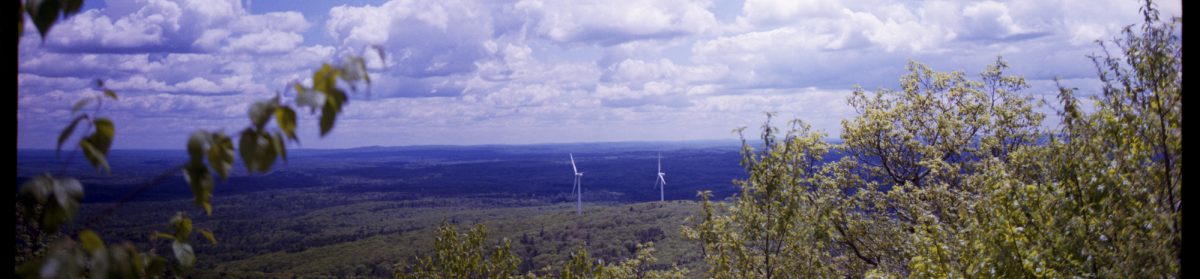
There are lenses that photographers recommend, and then there are lenses that sell entire camera systems. The Pentax 67 105mm f/2.4 belongs firmly in the second category. For decades, this unassuming standard prime has been the single biggest reason photographers buy into the Pentax 67 system — a camera that is itself enormous, heavy, and unapologetically mechanical. The 105mm is the reward for carrying all that weight.
Purchase the Pentax 105mm f2.4 at KEH.com
Purchasing through the link above helps support the site!
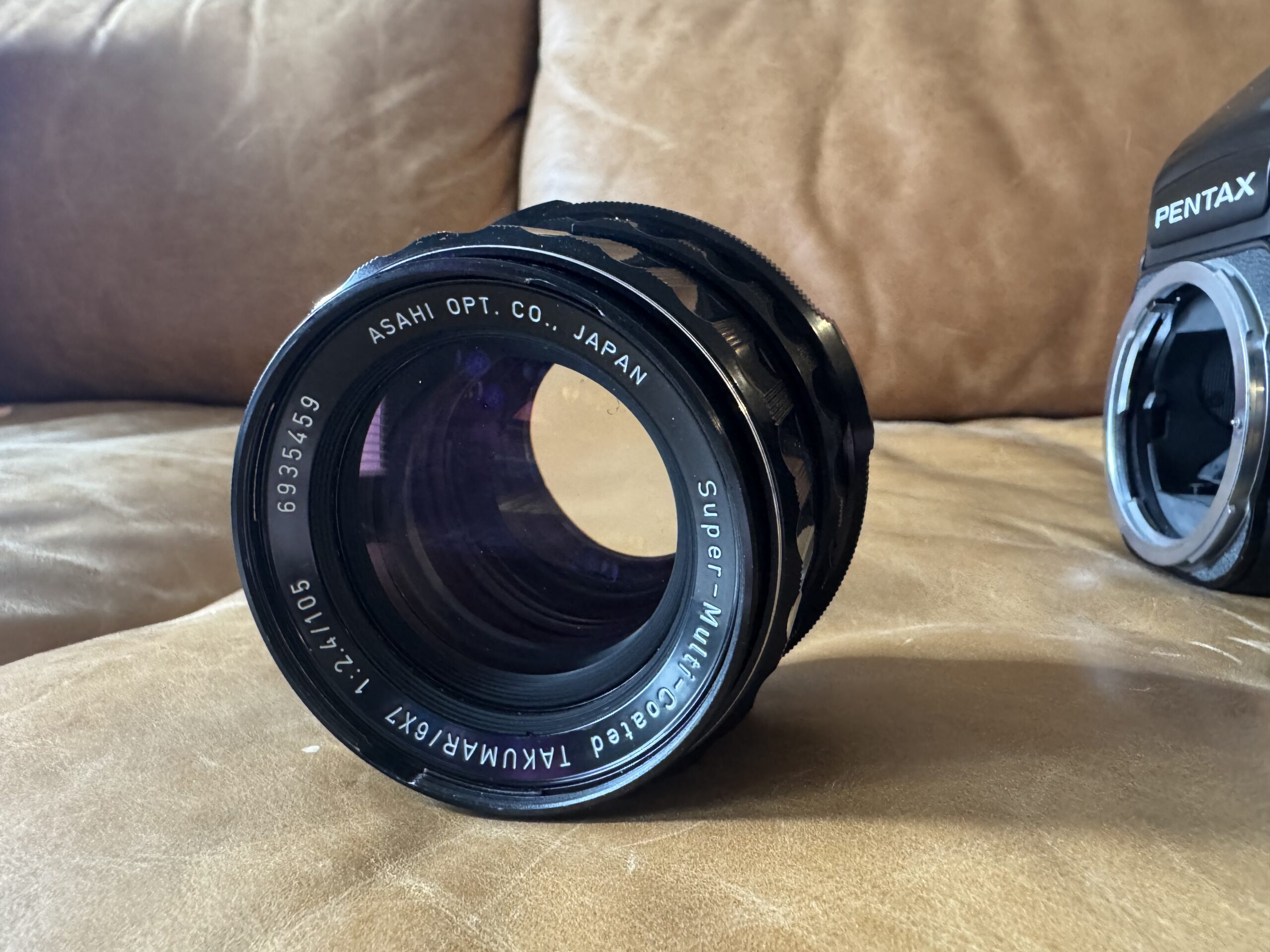
What makes it so special is not any one thing. It is the convergence of a fast aperture on a large negative, an optical formula that renders out-of-focus areas with uncommon beauty, and a flare characteristic so distinctive that photographers deliberately shoot into the sun to capture it. This is not a lens you buy because the specifications are impressive on paper. You buy it because the images it produces have a quality that is immediately recognizable and nearly impossible to replicate with other equipment.
The Large Format Look
The phrase gets thrown around loosely in photography circles, but with the 105mm f/2.4 on a 6×7 negative, it actually means something. The lens provides a field of view equivalent to roughly 52.5mm on 35mm film — a classic normal perspective. But the depth of field behavior is nothing like a normal lens on a smaller format. At f/2.4 on the massive 6×7 negative, the equivalent depth of field is closer to what you would get from a 50mm lens shot at approximately f/1.15 on a 35mm camera. That kind of subject isolation simply does not exist in the 35mm world.
The result is an image where the subject is rendered with startling clarity while everything in front of and behind the focal plane falls away with a gradual, almost three-dimensional quality. Photographers often describe this as “3D pop,” and while the term can feel overused, it is genuinely apt here. There is a depth and dimensionality to images from this lens that goes beyond simple background blur. The transition from sharp to unsharp is gradual and natural, with none of the harsh or nervous quality that faster lenses on smaller formats sometimes produce.
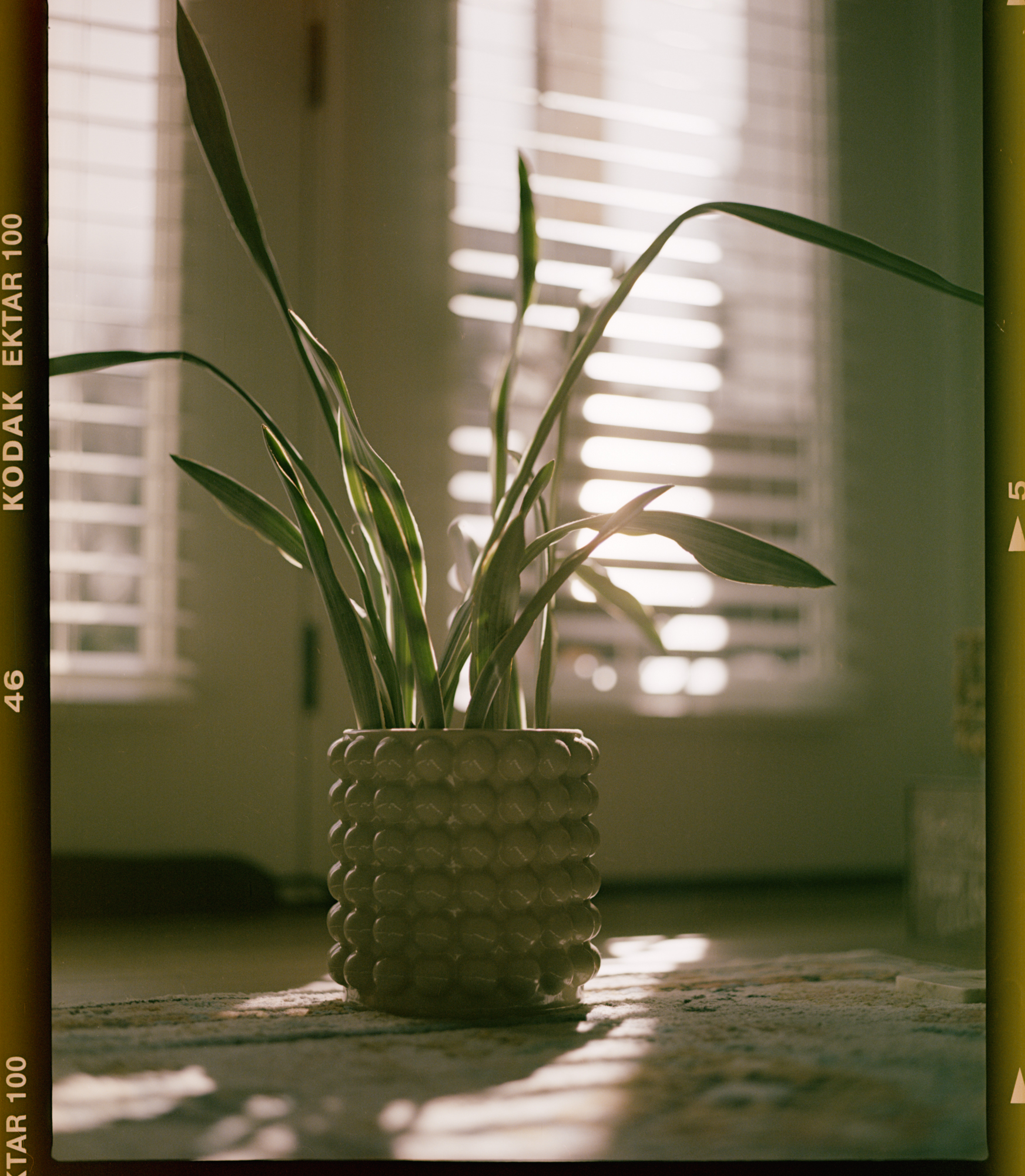
This is what draws portrait photographers to the lens above all else. A half-body portrait shot wide open on Portra 400 has a presence that is difficult to achieve any other way — the subject seems to exist in a different spatial plane from the background, with a sense of volume and weight that flatter rendering simply cannot match.
Bokeh Character
The bokeh from the 105mm f/2.4 is widely considered the gold standard for the Pentax 67 system and among the finest in all of medium format photography. The lens uses a 9-blade aperture diaphragm, which keeps out-of-focus highlights reasonably circular even when stopped down a click or two from wide open. At f/2.4, specular highlights in the background render as soft, evenly illuminated discs without the hard edges or onion-ring patterns that plague some modern designs.
What sets this lens apart from other excellent portrait optics — including its stablemate, the 90mm f/2.8 — is a subtle swirl in the bokeh at wide apertures. It is not the aggressive, distracting swirl of a Petzval or a Helios 44-2. It is gentler than that, more of a directional flow in the out-of-focus areas that draws the eye inward toward the subject. The effect is most visible when shooting against backgrounds with fine detail — foliage, distant textures, scattered light — and it gives the images a quality that many photographers describe as slightly magical. The 90mm f/2.8 and the 165mm f/2.8, both excellent lenses in their own right, produce bokeh that is smoother and more clinically correct, but also less characterful.
Wide open, the lens can show some softness in the extreme corners of the 6×7 frame, but this is rarely an issue in practice. Portrait and street photographers are seldom concerned with corner sharpness at maximum aperture, and the effect actually contributes to the natural vignetting that gives images from this lens their signature look.
Sharpness
The 105mm f/2.4 is sharp wide open in the center of the frame — not surgically sharp in the way of a modern APO-corrected design, but sharp enough that the limiting factor in most images will be focusing accuracy rather than the optic itself. The challenge is that the depth of field at f/2.4 on a 6×7 negative is extraordinarily thin, and nailing focus on a ground glass screen while handholding a five-pound camera is not trivial. Many photographers who report soft results with this lens are experiencing focus error, not an optical shortcoming.
Stopped down to f/5.6 or f/8, the lens becomes extremely sharp across the entire frame — sharp enough that the results are virtually indistinguishable from the 90mm f/2.8 at the same apertures. At f/8 to f/11, this lens will resolve everything the film can capture. The 6 elements in 5 groups optical formula is straightforward by modern standards, but its simplicity is part of what makes the rendering so clean and free of the clinical artifacts that more complex designs can introduce.
Flare: The Famous Red Orb
Most lenses are evaluated on how well they resist flare. The 105mm f/2.4 is one of the rare optics that is celebrated for how it flares.
When shot wide open directly into a strong backlight source — typically the sun at or near the horizon — the lens produces a distinctive warm orb of light in the frame. The flare manifests as a glowing reddish-orange or amber sphere, translucent and soft-edged, that sits in the image like a luminous ghost. It is not a hard, distracting artifact. It is closer to a wash of warm light that can be positioned deliberately within the composition.

The orb is visible in the viewfinder in real time, which means the photographer can move their body position to place it exactly where they want it — wrapping it around a subject’s head, floating it in the shadow area of a backlit portrait, or letting it bleed across the edge of the frame. The technique requires some practice, but once you understand the geometry, it becomes a reliable creative tool rather than an accident. The best results tend to come during the last minutes before sunset, when the sun is low and the light is warm, and with color negative film stocks like Portra that handle the highlights gracefully.
It is worth noting that the flare behavior varies somewhat with the lens generation. The earlier Takumar versions, with their simpler coatings, tend to produce more pronounced flare and a greater loss of overall contrast when shooting into strong light. The SMC Pentax 67 version, with its improved multi-coatings, controls flare more effectively and retains more shadow detail and contrast in backlit situations. Whether this is a benefit or a drawback depends entirely on your intent. Some photographers prefer the dreamier, lower-contrast look of the older versions when shooting backlit, while others value the SMC version’s ability to maintain image integrity while still producing the characteristic orb.
When you are not deliberately shooting into the sun, the lens handles contrast and flare competently with a proper lens hood attached. The standard PH-SB 67mm clip-on hood does the job, though some photographers prefer the deeper PH-SA 67mm hood designed for the 135mm and 150mm lenses, which provides slightly more shading without vignetting the 105mm’s field of view.
Build Quality and Handling
Regardless of generation, every version of this lens is built to professional standards. The older Takumar versions are tanks of machined metal — dense, cold to the touch in winter, and seemingly indestructible. The focus ring on these early versions has a beautifully damped feel, smooth and precise without any looseness or play. The aperture ring clicks into each stop with mechanical certainty.
The later SMC Pentax 67 version traded some of that all-metal tactility for a rubberized focus grip, which is arguably easier to use with gloves or in wet conditions but lacks the visceral satisfaction of the earlier metal rings. The overall construction is still excellent, though the body incorporates slightly more plastic and weighs about 38 grams less than the Takumar versions.
For a lens with a maximum aperture of f/2.4 covering the 6×7 format, the 105mm is remarkably compact. It is the smallest lens in most Pentax 67 kits, noticeably smaller than the 150mm f/2.8 or the 75mm f/4.5 AL. Mounted on the camera, it creates a well-balanced setup that handles naturally at eye level. The lens extends slightly as you focus toward closer distances, but the movement is minimal and does not affect balance in any meaningful way.
The 67mm filter thread is shared with several other lenses in the Pentax 67 system, which is a practical convenience — one set of filters covers multiple optics.
A Second Life on Digital
The 105mm f/2.4 has experienced a significant resurgence in popularity thanks to mirrorless digital medium format cameras, particularly the Fujifilm GFX series. Adapted via a simple mechanical adapter — or a focal reducer like the Kipon Baveyes 0.7x for even more of the large-format look — the lens translates its optical character faithfully to a digital sensor. The rendering, the bokeh, the 3D pop — it all carries over.
Check out my article on Adapting Pentax 67 lenses onto Fuji GFX Cameras
On the GFX, the lens demands manual focus, but focus peaking and punch-in magnification make this far more precise than working with a ground glass screen. Wedding and portrait photographers have adopted this combination as a way to get a look that even the best native GFX lenses do not quite replicate. There is a character to this fifty-year-old optical design that modern computer-optimized formulas, for all their technical superiority, have not managed to capture.

Pentax 105mm f2.4 shot on Fuji GFX 100s. Very different rendering compared to Kodak Ektar image below.

Who Is This Lens For?
The 105mm f/2.4 is not a versatile all-rounder. It does not focus close enough for tight headshots without accessories (I cover this in depth below). It is not weather-sealed. It does not autofocus. It requires you to carry a camera system that weighs as much as a small dumbbell.
But if you want to make portraits or environmental photographs with a rendering quality that approaches large format without the complexity of a view camera, this lens delivers that in a package you can actually handhold. It is, in many ways, the entire argument for the Pentax 67 system distilled into a single optic. The images it produces — that combination of sharpness, dimensionality, and bokeh — are why photographers continue to seek out these cameras decades after they were discontinued.
There are sharper lenses. There are faster lenses. There are lenses that focus closer and weigh less and cost a fraction of the price. But very few lenses at any price point, in any format, produce images that look quite like what comes out of the Pentax 67 105mm f/2.4. That is why it remains legendary.
Testing Minimum Focus Distance of The Pentax 105mm f2.4
As a first test-shot I photographed my wife’s flowers.
I don’t have a human model to take a pic of at the moment but this bouquet of flowers is just about the right size. At minimum focus distance, the background is very pleasing, just sort of melts away.

The above image was shot at minimum focus distance with the lens adapted to the GFX 100s.
What You Need to Know Across All Three Generations
The Pentax 105mm f/2.4 is one of the most celebrated standard lenses ever made for medium format photography. Designed for the Pentax 6×7 system, it has earned a reputation for razor-sharp rendering, gorgeous bokeh, and that elusive “3D pop” that medium format shooters chase. But one characteristic of this lens consistently catches newcomers off guard: its minimum focus distance. Notice the flowers above. I’m not very close to them.
At 1 meter (approximately 3.3 feet), the 105mm f/2.4 cannot focus nearly as close as many photographers expect from a standard lens. And that limitation holds true across all three generations of this optic.
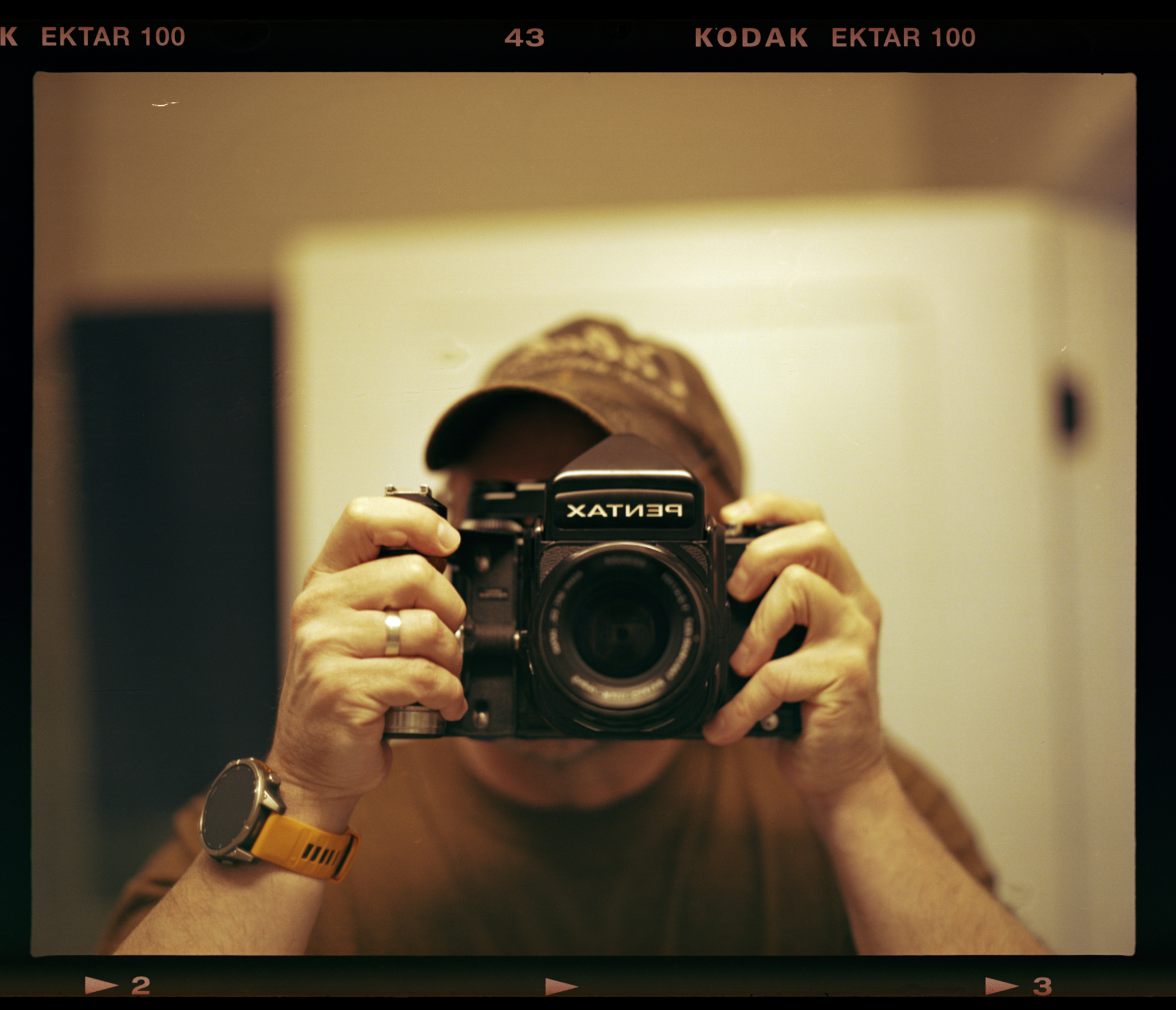
Self portrait taken with the Pentax 105mm f2.4. Kodak Ektar 100
Three Generations, One Focus Distance
Pentax produced the 105mm f/2.4 in three distinct versions over a span of two decades:
The Super Takumar (1969) was the original. Released alongside the Pentax 6×7 body itself, it featured an all-metal construction with a scalloped metal focus ring and aperture ring. It carried the “Super-Takumar” designation on the front element ring. This version used thorium-doped glass in its optical formula — a common practice at the time that could eventually cause a yellow color shift in the glass due to low-level radioactivity.
The Super-Multi-Coated Takumar (1971) was the second iteration. Externally, it was nearly identical to the first version — same metal focus ring, same physical dimensions, same weight. The key upgrade was in the lens coatings. Pentax’s Super Multi Coating technology improved contrast, reduced flare, and gave the lens better performance when shooting into or near strong light sources. However, this version also used thorium glass elements, and examples can sometimes be found with the same yellowing as the original Super Takumar. The only reliable way to tell the two apart is the labeling on the front of the lens. This is the version I own and have been testing.
The SMC Pentax 67 (1989) was the final and most refined version. Pentax gave the lens body a physical redesign — the scalloped metal focus ring was replaced with a rubberized grip, the cosmetics were modernized, and the lens shed a few grams of weight in the process. I actually prefer scalloped metal rings which is why I went with the previous version. One thing to note with the latest version is that the thorium glass elements were replaced with high-index non-radioactive glass, permanently solving the yellowing issue. The improved SMC coatings on this version are also credited with slightly better micro-contrast and flare resistance compared to the earlier versions.
Despite all of these changes in coatings, glass formulation, and physical design, the underlying optical formula remained unchanged across all three generations: 6 elements in 5 groups. And critically, the minimum focus distance remained fixed at 1 meter (100cm / 3.3 feet) on every version.
Why 1 Meter Matters
For a lens that is often described as a portrait powerhouse, 1 meter is a meaningful constraint. At minimum focus distance, the 105mm f/2.4 frames roughly a half-body composition on the 6×7 negative. Tight headshots are simply not possible without accessories. You cannot rack the focus ring past that 1-meter mark and get any closer to your subject.

Taken by my wife with the GFX 100s, Kipon Adapter, and Pentax 105mm f2.4
This is a sharp contrast to its sibling in the Pentax 67 lineup, the 90mm f/2.8, which focuses down to just 0.65 meters (about 2.1 feet). That closer focus capability makes the 90mm far more versatile for tight portraits, tabletop work, and environmental close-ups — though it trades away the 105mm’s faster aperture and slightly longer working distance.
For context, at 1 meter with the 105mm f/2.4 wide open at f/2.4, the depth of field on a 6×7 negative is extraordinarily thin. The combination of the large negative, the relatively long focal length, and the fast aperture means that even at minimum focus distance, the plane of sharp focus is a sliver. This is part of what gives the lens its legendary rendering — backgrounds dissolve into a creamy wash of out-of-focus tones with the lens’s 9-blade aperture producing smooth, rounded highlights.
Working Around the Limitation
Pentax anticipated the desire for closer focusing and offered accessory solutions within the 67 system.
The Pentax S82 close-up lens (67mm filter thread) was specifically designed for use with the 90mm f/2.8, 90mm LS, and the 105mm f/2.4. When attached to the 105mm, it allows focusing from 1 meter down to approximately 0.5 meters, yielding a maximum magnification ratio of roughly 0.25x — enough for a tight headshot on the 6×7 negative.
Extension tubes are another option. The Pentax 67 Extension Tube #1 adds enough spacing between the lens and the film plane to push the magnification beyond what the bare lens can achieve, at the cost of some light loss and the inability to focus at infinity.
Both solutions are lightweight and easy to carry in a bag, making them practical additions for portrait sessions where you know you will want to get closer than the lens allows on its own.
So Which Version Should You Buy?
Since the minimum focus distance is identical across all three versions, it should not be a factor in your purchasing decision. The choice comes down to other considerations.
The Super Takumar is typically the most affordable option on the used market. Its potential for yellowed glass can actually be reversed by exposing the rear element to UV light (sunlight or a UV lamp) for a few days. If you are budget-conscious and do not mind a little maintenance, it is a perfectly capable lens.
The Super-Multi-Coated Takumar offers improved coatings over the original at a moderate price increase. It can also exhibit yellowing, though some examples have remained clear. Mine has no yellowing. It shares the same satisfying all-metal build as the first version.
The SMC Pentax 67 commands the highest prices but brings peace of mind with its non-radioactive glass, the best coatings of the three, and a slightly modernized feel. If you shoot backlit subjects frequently or want the absolute best flare resistance, this is the version to seek out.
No matter which generation sits on the front of your Pentax 67, you are getting the same fundamental optical design, the same 1-meter minimum focus distance, and the same ability to produce images with a dimensionality and presence that few lenses in any format can match.
Thinking about purchasing this lens? Search for the Pentax 105mm f2.4 at KEH.com
Purchasing through the link above helps support the site!
Purchasing gear from the above link helps me keep the site going!