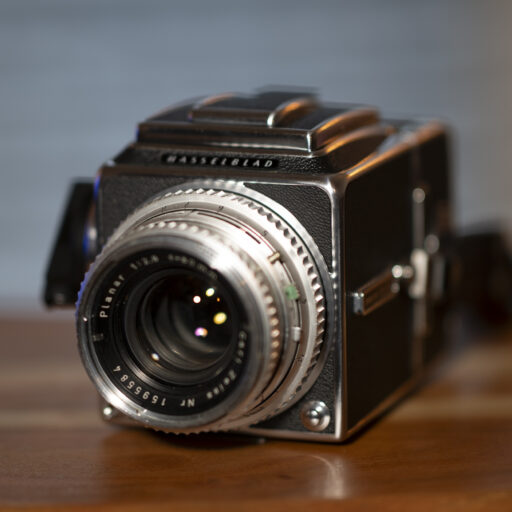
I chose the Hasselblad 500cm to begin my medium format film journey for several compelling reasons:
Complete modularity. The 500cm separates into distinct components—body, lens, viewfinder, and film back—each of which can be swapped independently. This design allows you to carry multiple loaded backs for fast film changes in the field, switch between waist-level and prism finders depending on the situation, and adapt the system to various shooting styles.
Fully mechanical operation. The 500cm requires no batteries for any function. The Compur leaf shutters in the lenses are mechanically governed, and the body’s mirror and film advance mechanisms are purely mechanical. This camera will function identically in fifty years as it does today, requiring nothing more than occasional servicing.
Timeless design and system longevity. The V-system Hasselblads have been in production since 1957, with lenses, backs, and accessories remaining compatible across decades. The used market offers abundant options, and Hasselblad still services these cameras. You can even purchase a digital back that converts this 70-year-old design into a modern digital medium format camera.
Waist-level viewing. I prefer composing on a ground glass with the camera at chest level rather than pressed against my face. The waist-level finder creates a more contemplative shooting experience—you’re looking down into a representation of the scene rather than through a window at it. The image appears reversed left-to-right, which initially confuses but eventually becomes natural and even helps compositional decisions.
Working with the Zeiss 80mm f/2.8 Planar
The lens I acquired with the 500cm is the Zeiss 80mm f/2.8 Planar—the only f/2.8 lens available for this system. Most Hasselblad lenses have maximum apertures of f/4 or slower, and after shooting with the 2.8 Planar, I understand why.
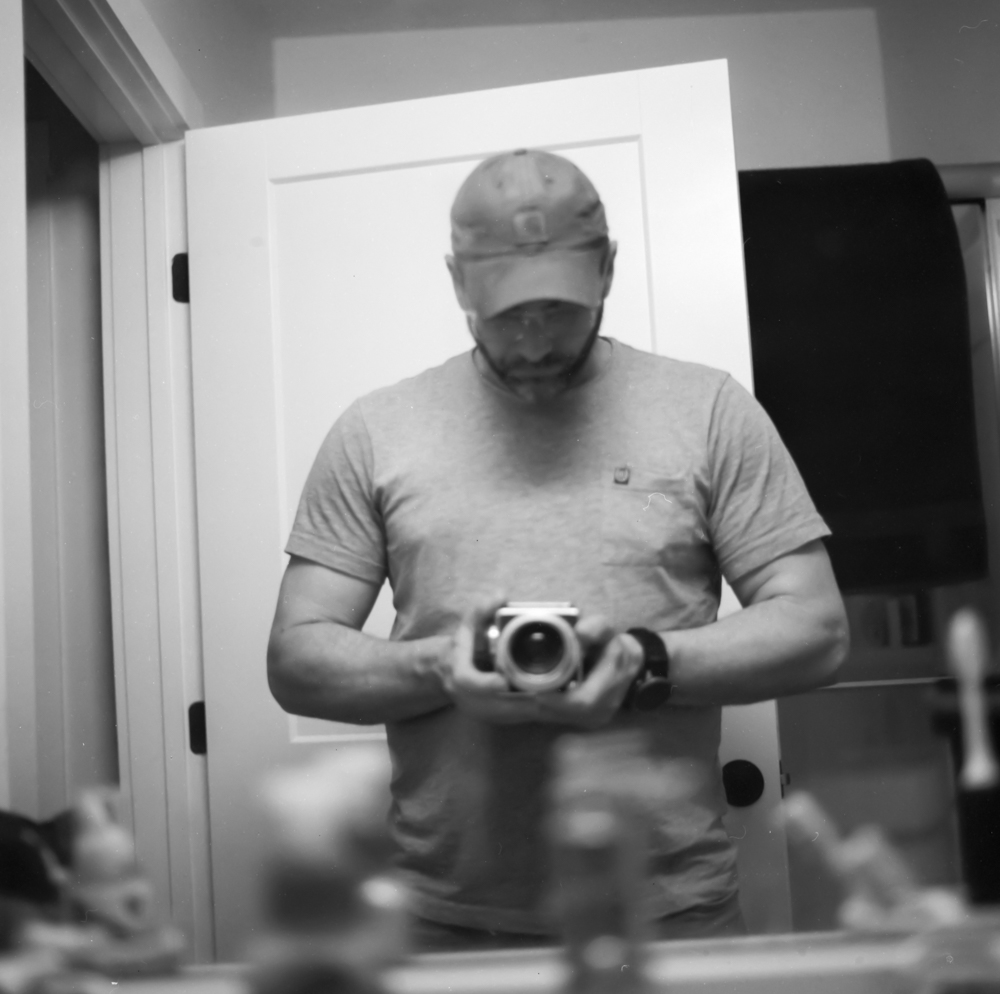
Nailing focus with the Hasselblad at f/2.8 is genuinely difficult. The waist-level finder’s ground glass, while beautiful for composition, provides limited focus precision at wide apertures. The depth of field at f/2.8 on a 6×6 negative is razor-thin, and the combination of manual focus, no focus confirmation, and a dim viewfinder makes consistent results challenging.
The magnifying hood attachment helps significantly—popping it up provides a closer view of the ground glass center for critical focus—but even with it, f/2.8 requires discipline and practice. Most of my successful portraits with this lens happen at f/4 or f/5.6, where the depth of field provides some margin for error.
Purchasing gear from the above link helps me keep the site going!