There are developers that photographers use, and then there are developers that photographers believe in. Rodinal, or Adonal as it’s sometimes branded, belongs in the second category. It is one of the oldest photographic chemicals still in active production — a concentrate so simple, so stable, and so opinionated in its results that it has outlasted empires, companies, and entire photographic formats. If you are shooting medium format film in the 21st century, Rodinal is not a curiosity from the past. It is a living tradition.
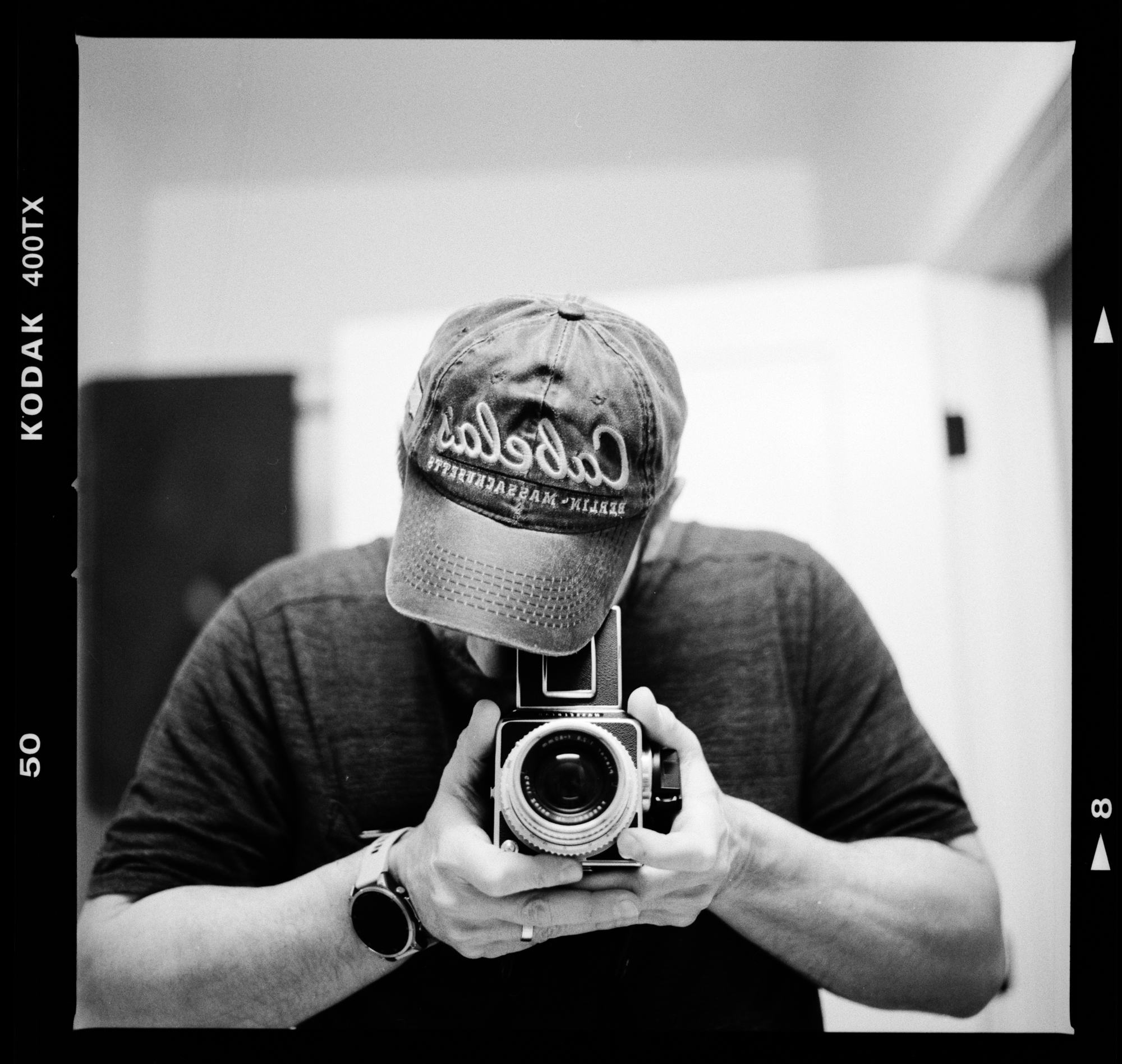
Self portrait developed in Rodinal at 1:25 concentration for 8 minutes.
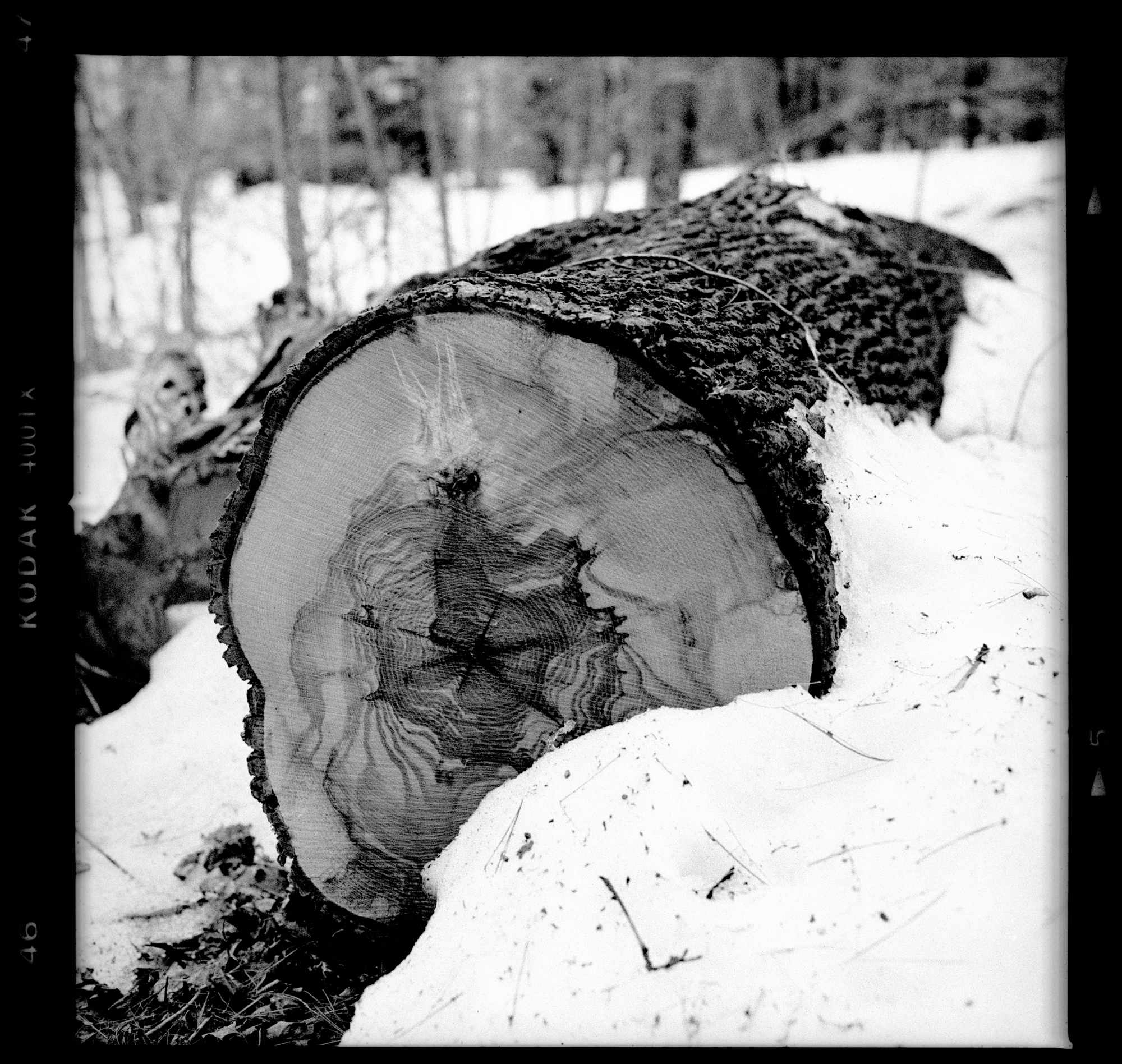
A log at the park. Rodinal at 1:25 concentration for 8 minutes.
A Brief History: From Agfa’s Laboratories to Your Darkroom
Rodinal was first introduced to the photographic world in 1891 by Dr. Momme Andresen, a chemist working at the German firm Agfa (Aktien-Gesellschaft für Anilin-Fabrikation). The formula was elegant in its simplicity: para-aminophenol (p-aminophenol) as the primary developing agent, potassium hydroxide as the alkali, and sodium sulfite as a mild preservative. That’s essentially it. No complex superadditive partnerships, no hydroquinone, no phenidone — just a single powerful reducing agent in a highly concentrated alkaline solution.
What made Rodinal remarkable from the start was what it didn’t do: it didn’t suppress grain, it didn’t smooth edges, and it didn’t pretend that film was anything other than a collection of silver halide crystals responding to light. Where other developers of the era chased smoothness, Rodinal delivered acutance — edge sharpness, micro-contrast, the hard delineation between tones that gives a black-and-white print a certain presence on the wall.
Agfa marketed Rodinal in various incarnations for over a century, eventually renaming it R09 in some markets. Then, in 2008, Agfa Photo — the consumer arm of the company — declared insolvency, and for a moment it seemed as if Rodinal might finally die. It did not.
Adox Rodinal: Same Formula, New Steward
This brings us to the question many photographers ask: Is Adox Rodinal the same as original Rodinal, or is it a knockoff?
The short answer is: it is as close to original Rodinal as anything commercially available today.
Adox (Adolff, a German company with deep roots in the photographic chemistry industry) acquired the rights to the original Agfa Rodinal formula and has been producing it under the name Adox Rodinal since the post-Agfa era. The chemistry — p-aminophenol hydrochloride in a concentrated alkaline solution — is identical to the classic formulation. Adox has been transparent about this, and the darkroom community has subjected both generations of the product to exhaustive comparative testing. The results are indistinguishable.
It is worth noting that several other “Rodinal-compatible” products exist under different trade names: Blazinal (Canada), Calbe R09 (Eastern European production), FOMA R09 (Czech Republic), and Compard R09 One Shot. These are all variations on the same p-aminophenol chemistry, though minor formulation differences exist. Adox Rodinal is generally considered the most faithful to the original Agfa formula.
So when you open a bottle of Adox Rodinal, you are using a formula that Andresen would recognize from 1891. That is an extraordinary thing.
The Chemistry of Grain: Why Rodinal Looks the Way It Does
To understand why Rodinal produces the grain characteristics it does, you need to understand what a “compensating” versus “solvent” developer means.
Solvent developers — like Kodak D-76 or Ilford ID-11 — contain high concentrations of sodium sulfite. Sulfite dissolves the outermost edges of silver halide crystals during development, effectively smoothing and shrinking grain clumps. The result is finer-looking grain, better shadow detail, but somewhat softer overall acutance.
Rodinal is the opposite. Its sulfite concentration is extremely low. The grains develop fully and are not chemically dissolved or smoothed. The result is pronounced, distinct, individual grain — and crucially, those grains have hard edges. This is the source of Rodinal’s famous acutance effect: the Mackie lines and edge enhancement that occur at high-contrast transitions give Rodinal-developed negatives their characteristic “bite.”
At the pixel level (or silver crystal level), Rodinal produces what photographers describe as “grain with structure” — not random noise, but organized, visible, almost architectural grain that reads as texture rather than defect.
Concentration and Development Time: How Grain Changes
Rodinal’s single greatest variable — and its most powerful creative tool — is dilution. Unlike developers with fixed working solutions, Rodinal is used as a concentrate diluted at the time of development, and the ratio changes everything.
1:25 — Classic, Punchy, Grain-Forward
At 1:25 (1 part Rodinal to 25 parts water), you get the most active, contrasty, and grain-emphasized results. Development times are short — typically 5 to 10 minutes at 20°C depending on film speed. The developer is working quickly, exhausting rapidly, and the grain is at its most pronounced.
This is a high-acutance combination. The grain clumps are visible and distinct. Shadow detail can compress slightly because the developer exhausts before it fully penetrates deep into dense shadow areas. The overall look is bold, graphic, and deeply “filmic” — the kind of image that couldn’t be mistaken for digital.
At 1:25 with Kodak Tri-X 400TX in medium format (as in the photographs accompanying this article), you get exactly this: a visible, structured grain that reads as classic black-and-white photography. The grain doesn’t fight the image — it completes it.
1:50 — The Sweet Spot
The 1:50 dilution is where most photographers live with Rodinal. Development times stretch to 11–14 minutes at 20°C for most ISO 400 films. The additional water means the developer is more dilute in the emulsion, working more slowly and more evenly.
Grain at 1:50 is still fully present — this is Rodinal, after all — but it tends to be slightly more evenly distributed, with marginally improved shadow separation compared to 1:25. Acutance remains extremely high. This is a beautiful general-purpose combination for medium format work, particularly when you want film to look like film without screaming it.
1:100 — Stand Development and the Compensating Effect
At extreme dilutions like 1:100, Rodinal transitions into a compensating developer used for stand or semi-stand development. Development times stretch to 60 minutes or longer with minimal or no agitation (agitation typically only at the very beginning and perhaps once at the midpoint).
Something interesting happens at this dilution: because the developer is so dilute, it exhausts quickly in the dense highlight areas of the negative (where the most silver is being developed) while continuing to work in the thinner shadow areas. This self-compensating action compresses highlights and opens shadows simultaneously — a remarkable feat for a single-bath developer.
Grain at 1:100 stand development is paradoxically more clumped in some areas, particularly if agitation causes streaking (a common problem with stand development). But overall tonal gradation can be smoother and more extended than at shorter dilutions. Many photographers use this technique with high-speed films like Delta 3200 or when they need to rescue badly exposed negatives.
The Storage Properties: Rodinal’s Greatest Secret
If Rodinal’s grain character is its personality, its storage longevity is its superpower.
Most liquid film developers have a shelf life measured in months once opened — oxygen exposure causes oxidation, and the developer gradually becomes less active and unpredictable. Some photographers have ruined irreplaceable negatives with old developer that had gone off without obvious warning signs.
Rodinal does not behave this way.
The concentrated formula (Rodinal is sold at high concentration, intended to be diluted just before use) oxidizes only at the very top surface of the liquid in the bottle. The layer below remains fresh. Photographers routinely report using Rodinal that is 10, 15, even 20 years old with no meaningful loss of performance. There are documented accounts of Rodinal from the Agfa era — decades old — being tested and found still functional.
The chemistry behind this is straightforward: the high alkalinity and concentration of p-aminophenol create an environment that is relatively hostile to rapid oxidation throughout the bulk of the solution. The oxidized surface layer acts as a kind of sacrificial cap, protecting what’s below.
In practical terms, this means you can keep a bottle of Adox Rodinal on your darkroom shelf for years, pull it out for a sporadic project, and know that it will perform exactly as expected. For photographers who shoot film infrequently — or who develop in batches separated by months — this is genuinely liberating. No other commonly available developer approaches this stability.
The one caveat: as you use the bottle down, the surface-to-volume ratio increases, and the oxidized cap becomes proportionally larger relative to fresh developer. Some photographers squeeze air out of partially used bottles, use bladder-style containers, or top off with marbles to minimize headspace. But even without these precautions, Rodinal’s longevity is exceptional.
On These Two Photographs: Kodak Tri-X 400TX in Medium Format, Adox Rodinal 1:25, 8 Minutes
Both of the photographs in this article were shot on Kodak Tri-X 400TX in a medium format camera and developed in Adox Rodinal at 1:25 for 8 minutes. Looking at them closely through the lens of what we know about this developer, several things stand out.
Image One: Mirror Self-Portrait with Hasselblad
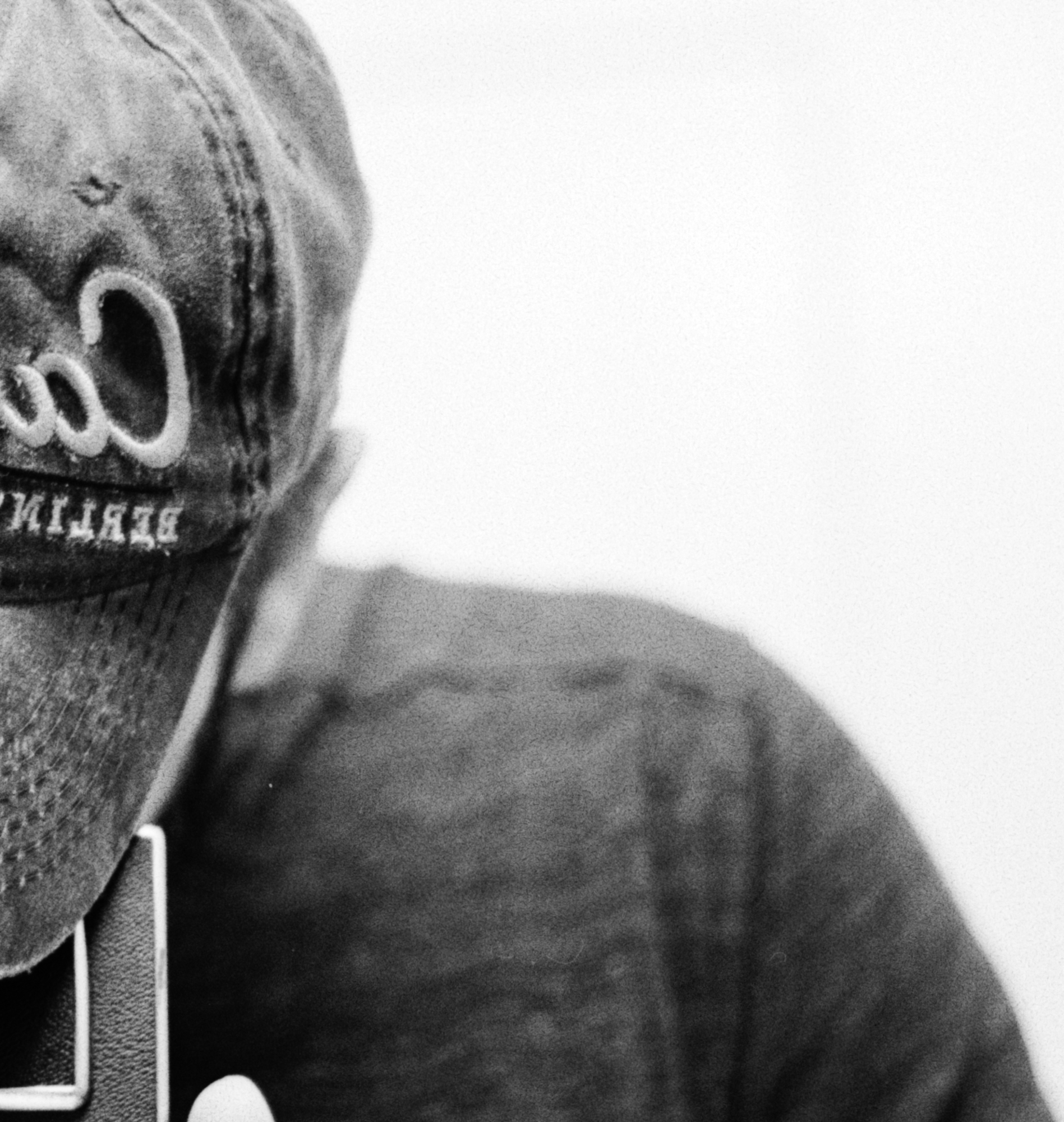
The grain here is doing real work. In the smooth tonality of the white wall behind me, you can see Rodinal’s grain character clearly: defined, structured, not random digital noise but organized silver crystal clusters with actual shape. The gray t-shirt renders beautifully — a mid-tone where Rodinal’s acutance shows as micro-contrast within the fabric texture. The hat brim and the camera’s leather body have excellent shadow detail, which is notable for 1:25 development, where shadow compression can be an issue.
The overall tonality is rich without being blocked in the highlights. The white wall retains detail. This suggests the exposure was well-judged — Tri-X 400TX has enough latitude to handle Rodinal’s relatively high contrast at 1:25 without blowing out highlights, and the medium format negative size means the grain, while present, doesn’t overwhelm the image at normal viewing distances.
Image Two: Felled Log in Snow, Winter Woods
This is the stronger of the two images as a study in what Rodinal does best.
The subject — the cross-section of a large felled tree resting in deep snow, bare winter woods receding into bokeh behind it — is essentially a still life of textures. And Rodinal at 1:25 has rendered each texture decisively differently from the others.
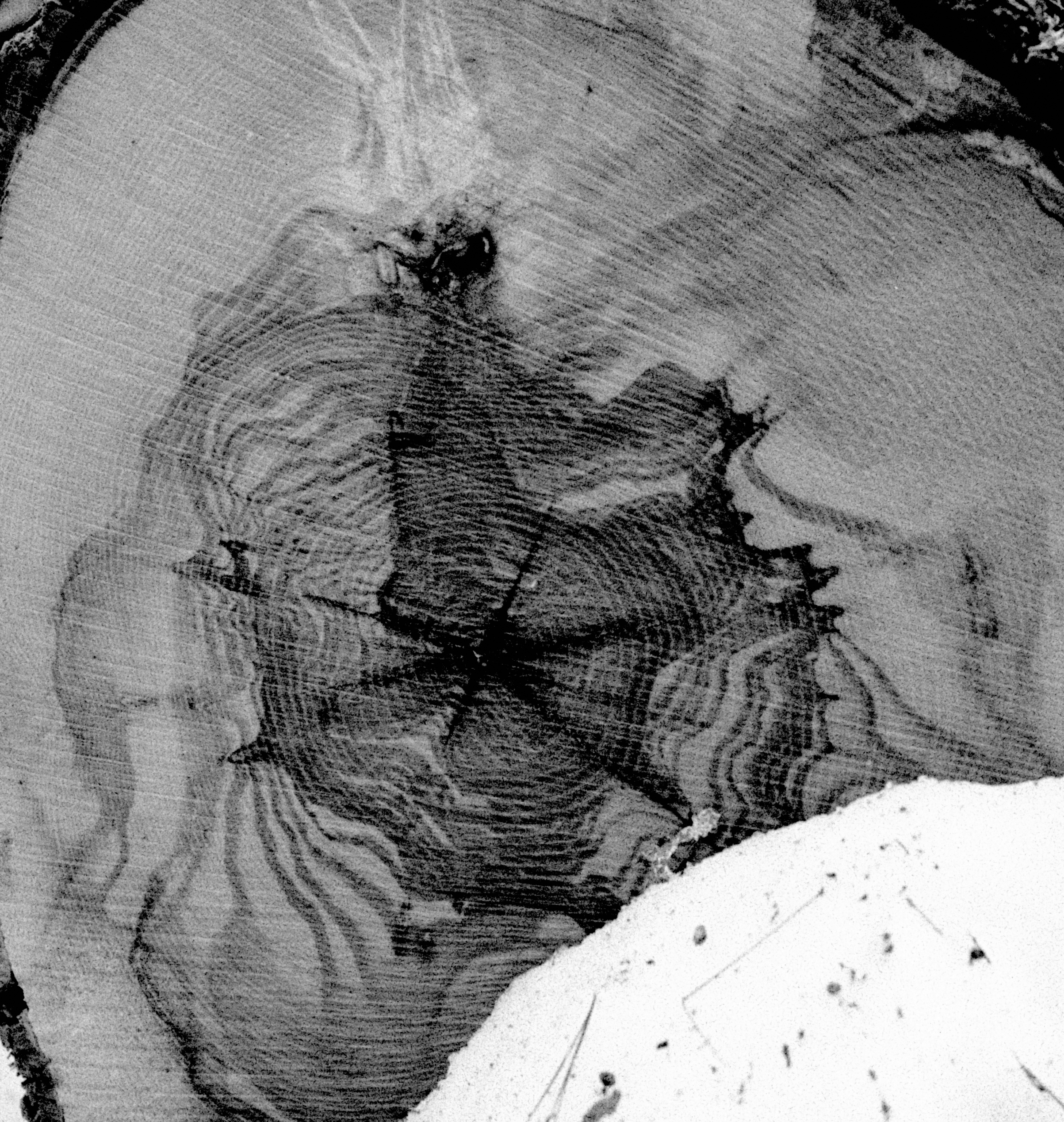
The end grain of the log is extraordinary. The annual rings, radial cracks, and the complex pattern of the heartwood versus sapwood are rendered with surgical clarity. The high acutance of Rodinal has emphasized every edge within the wood structure — you can trace individual growth rings, see the differential hardness between early and late wood, and read the history of the tree in the photograph. This is Rodinal doing what no solvent developer could do as well.
The snow is luminous without being blocked. It reads as white while retaining surface texture — you can see debris, twigs, and shadow detail in the snow near the log’s base. This is the kind of highlight retention that well-exposed Tri-X provides, and which Rodinal’s moderate shadow/highlight behavior preserves.
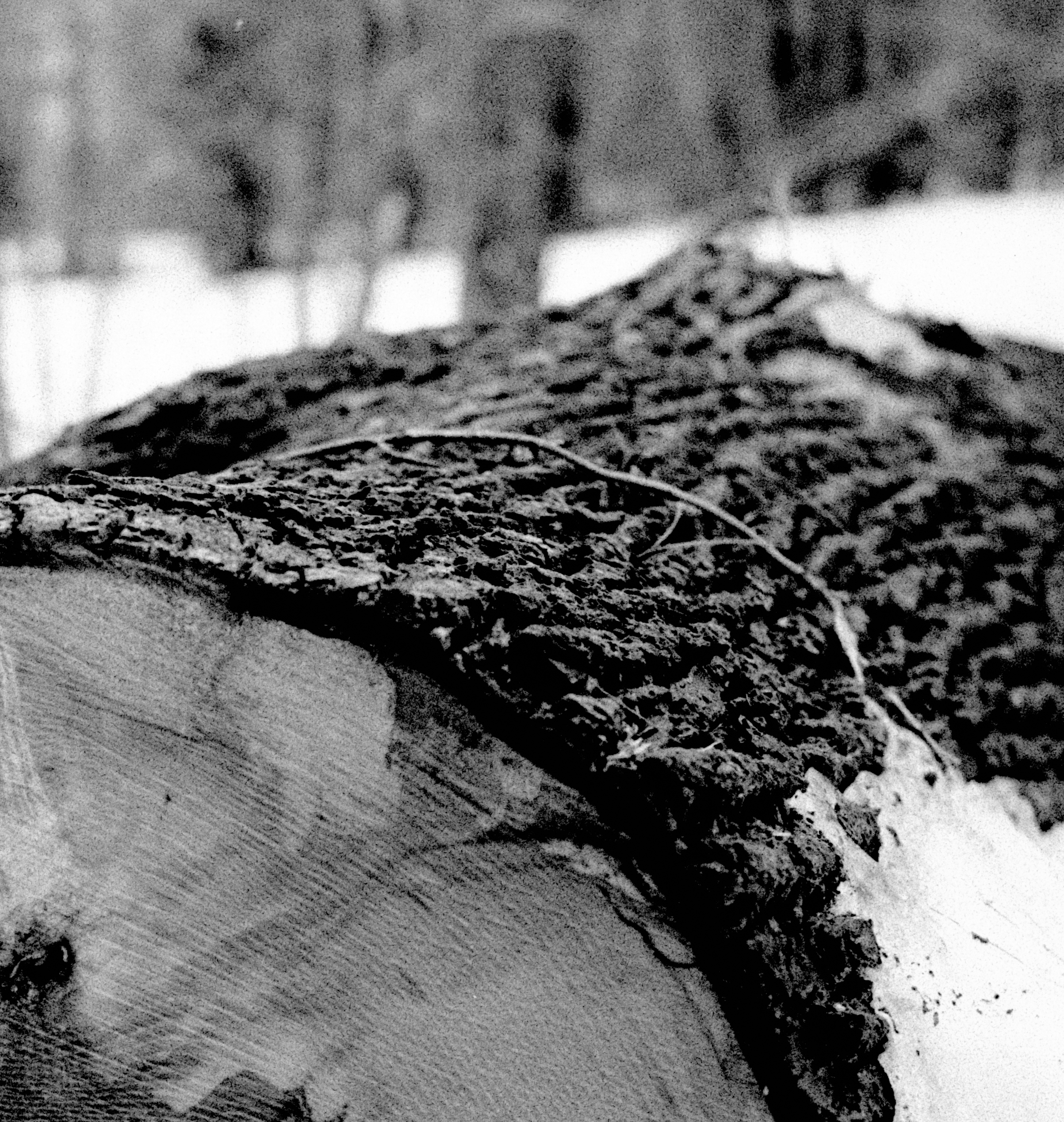
The bark on the upper surface of the log is deeply textured and dark — the roughest tonal transition in the image — and the grain in this area is most visible. Rodinal’s grain tends to be most apparent in mid-to-shadow tones, and the bark confirms this: it has a beautiful, almost etched quality.
The out-of-focus background trees are ghostly and atmospheric, their fine branches rendered as soft tonal gradations yet with strong grain. This illustrates how Rodinal’s grain pattern emerges most strongly in mid-tones and how the shallow depth of field at medium format focal lengths works with the developer’s character rather than against it.
Together, these two images are an honest document of what Rodinal at 1:25 does with Tri-X in medium format: grain that is present and photographic, acutance that rewards detailed subjects, and tonality that is bold without being brutal.
A Developer for Photographers Who Want Film to Look Like Film
Adox Rodinal is not a developer for photographers who want their film to approximate digital. It is not the tool you reach for when grain is the enemy. It is, instead, the developer for photographers who understand that grain is not a flaw — it is the evidence of silver, of chemistry, of a physical process that no algorithm has fully replicated.
Its 130-year history is not nostalgia. It is proof. The formula Andresen developed in 1891 continues to produce negatives that reward printing, whether in a darkroom on silver gelatin paper or scanned for digital output. Adox has been a faithful steward of that tradition.
The bottle on your shelf may well outlast your camera. That is not a metaphor. That is Rodinal.
Photographs: Kodak Tri-X 400TX, medium format Hasselblad 500cm with the 80mm f2.8, Adox Rodinal 1:25, 8 minutes @ 20°C.
Purchasing gear from the above link helps me keep the site going!