If there’s one black and white film stock that has earned its place in nearly every film photographer’s bag, it’s Ilford HP5 Plus. It’s not the sharpest. It’s not the finest grained. It’s not even the most visually striking at box speed. But HP5 is the film you reach for when you need to get the shot — and that reliability has made it one of the most important emulsions in the history of photography.
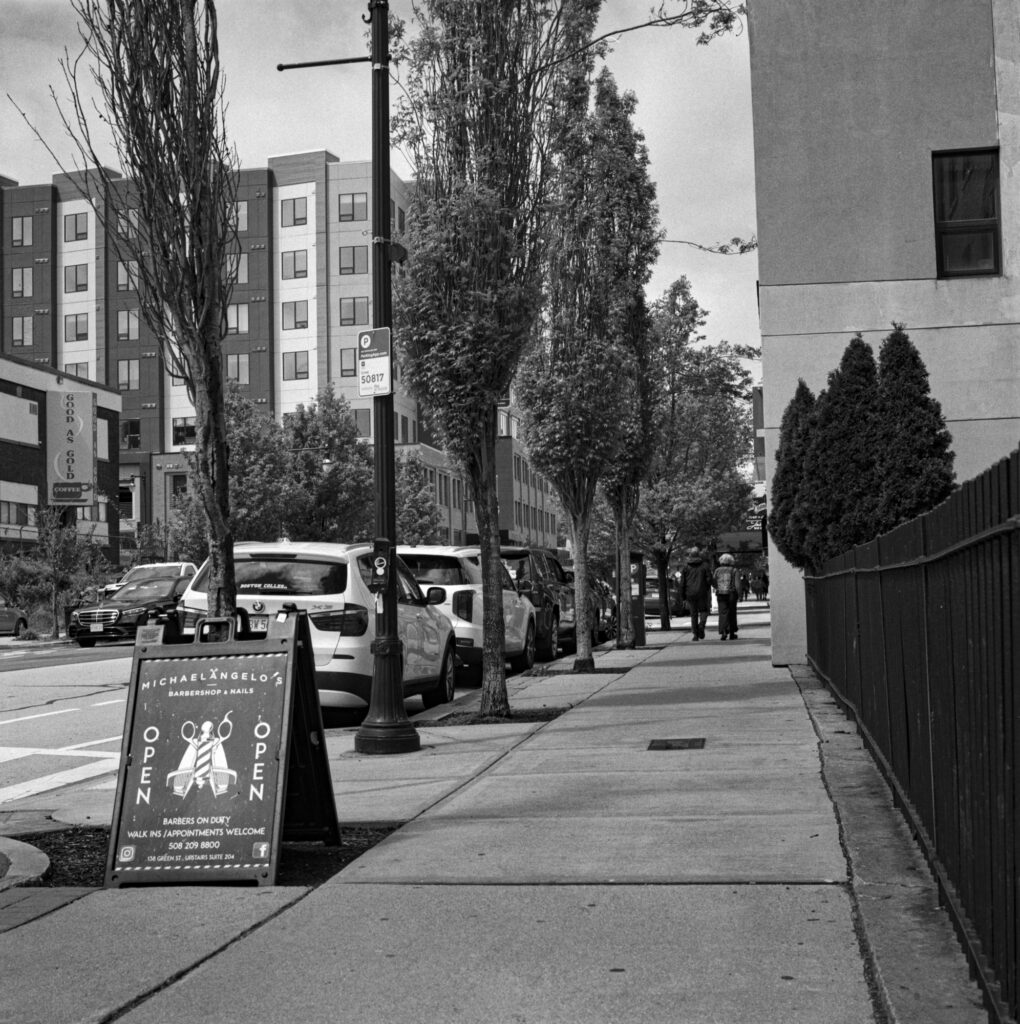
I’ve shot HP5 in everything from the Hasselblad 500cm to the Pentax 67, and large format 4×5, and 8×10. Here’s what you need to know about this film — where it came from, what makes it tick, and how to get the best results out of it in the darkroom.
A Brief History of HP5
The “HP” in HP5 stands for Hypersensitive Panchromatic — a designation Ilford introduced way back in 1931 with the original HP film. That first emulsion was a fast film for its era, and it set the stage for a lineage that would span nearly a century.
Ilford updated the line several times over the decades. HP3 arrived in the 1960s, followed by HP4 in 1965, which became a staple among photojournalists and documentary photographers who needed speed and versatility in unpredictable conditions.
HP5 launched in 1976 as a 400-speed black and white negative film, and in 1989 Ilford reformulated it as HP5 Plus — the version we still shoot today. That reformulation brought improved grain structure, better push-processing characteristics, and enhanced tonal response, particularly in the shadow regions where earlier versions could get muddy.
HP5 Plus is manufactured by Harman Technology (the successor to Ilford Photo) at their factory in Mobberley, Cheshire, England — the same facility where Ilford has been coating film since the 1920s. It’s available in 35mm, 120, and large format sheet sizes, making it one of the most accessible black and white films on the market.
What Makes HP5 Plus Special
HP5 is rated at ISO 400, which puts it in the sweet spot for handheld shooting in a wide range of conditions. But its real strength isn’t box speed — it’s the range of speeds you can push it to and still get usable results.
Versatile speed range. HP5 can be shot anywhere from ISO 200 (pulled one stop) to ISO 3200 (pushed three stops) with adjusted development. Some photographers push it even further. That kind of flexibility is almost unmatched in the black and white world.
Classic grain structure. HP5 uses a traditional cubic silver halide crystal structure, which gives it a grain pattern that reads as distinctly analog. At box speed in medium format, the grain is present but well-controlled — visible enough to give images texture without overwhelming detail. In 120 format especially, the larger negative keeps grain very manageable. It’s one of the reasons HP5 pairs so well with cameras like the Pentax 67, where the 6×7 negative gives you enormous room to breathe.
Wide tonal range. HP5 renders a long, smooth tonal scale from deep blacks through to clean highlights. It doesn’t crush shadows the way some faster films do, and it holds highlight detail well — a forgiving characteristic that makes it friendly to meter and easy to print.
Latitude for days. Like Kodak Portra in the color world, HP5 is remarkably tolerant of exposure errors. Overexpose it by a couple stops and you’ll get denser negatives with beautiful shadow detail. Underexpose it moderately and you’ll still pull a printable image. For medium format shooters who don’t always have the luxury of a quick meter reading, this matters.
HP5 vs. Kodak Tri-X
You can’t talk about HP5 without addressing Tri-X — Kodak’s equivalent 400-speed black and white film and HP5’s most direct competitor. Photographers have been debating these two for decades, and both have passionate followings.
Tri-X tends to have slightly more contrast and a grittier, punchier grain structure. It’s the classic photojournalism and street photography look — bold, contrasty, with deep blacks. HP5, by comparison, is a little smoother and more even-tempered. It has a longer tonal scale at box speed and responds more gracefully to push processing, especially at two and three stops.
In medium format, I find HP5 slightly easier to work with in the darkroom. The negatives scan and enlarge with a bit less effort, and the tonal range gives you more room to maneuver during printing. But this is genuinely a matter of preference — both are outstanding films, and if you shoot one, it’s worth trying the other.
Developing HP5 Plus at Home
This is where HP5 really shines. It’s one of the most well-documented films in the world when it comes to development data, and it responds well to a wide variety of developers. If you’re already developing film at home, adding black and white to your workflow is straightforward — and honestly easier than C-41, since temperature control is far less critical.
Developer Choices
HP5 plays nicely with almost every common black and white developer. Here are the ones worth knowing about:
Ilford ID-11 (or Kodak D-76). These two developers are essentially identical formulas and represent the standard starting point. ID-11 at stock dilution gives you fine grain with full film speed and a beautiful tonal range. Development time at 20°C is approximately 6.5 minutes for box speed. This is where I’d start if you’ve never developed HP5 before.
Ilford Ilfosol 3. A liquid concentrate that’s convenient and produces slightly more visible grain than ID-11, but with good sharpness. It’s a solid everyday developer if you want simplicity — mix, pour, develop, dump. Development time at 1+9 dilution is around 4.5 minutes at 20°C.
Ilford Microphen. A speed-increasing developer that’s specifically designed for push processing. If you plan to shoot HP5 at 800, 1600, or 3200, Microphen is the developer to reach for. It provides about a half-stop of genuine speed increase and keeps grain well-controlled even at extended development times.
Kodak HC-110. A versatile liquid concentrate with a long shelf life. Dilution B (1+31) gives approximately 5 minutes at 20°C. HC-110 produces a slightly different tonal curve than ID-11 — a bit more contrast in the midtones, which some photographers prefer for subjects with a lot of texture.
Rodinal (Agfa/Adox). The oldest developer still in production, and a favorite for stand development. Rodinal at high dilutions (1+100 or 1+200) with minimal or no agitation for 60 minutes produces a unique look — pronounced grain with exceptional sharpness and a long tonal scale. It’s not for everyone, but if you like gritty, detailed negatives with character, it’s worth trying. At 1/20th dilution it works more like conventional developers and produces a comparable look. Rodinal is great if you don’t develop much film and your bottle is going to sit around for a while. It doesn’t degrade as quickly as the other developers. Or ever really.
Development Tips
Temperature matters less than you think. Unlike C-41 color processing where a degree or two can shift your colors, black and white development is more tolerant. Standard is 20°C (68°F), but anywhere from 18°C to 24°C is workable — just adjust your development time accordingly. Ilford publishes time adjustments for different temperatures.
Agitation is where consistency lives. My approach: continuous agitation for the first 30 seconds, then four gentle inversions every 30 seconds for the remainder of the development time. Consistent agitation prevents streaking and uneven development — one of the most common issues in home processing.
Use a proper stop bath. Some people use water as a stop bath for black and white film, and you can get away with it, but a proper acid stop bath (like Ilford Ilfostop) halts development instantly and extends your fixer life. It’s cheap insurance.
Don’t skimp on fixing. Ilford recommends Rapid Fixer at 1+4 for 2–5 minutes. Under-fixed negatives will have a milky, purple tint and will deteriorate over time. When in doubt, fix longer rather than shorter.
Final rinse matters for archival quality. The hard water spots that plague film photographers are easily avoided with a few drops of wetting agent (Ilfotol or Photo-Flo) in your final rinse. Use distilled water if your tap water is particularly mineral-heavy.
Push Processing Times (20°C, ID-11 Stock)
Here are approximate starting times for push processing HP5 in ID-11 at stock dilution. These are starting points — bracket your first roll and adjust based on your results.
- ISO 400 (box speed): 6.5 minutes
- ISO 800 (push +1): 9.5 minutes
- ISO 1600 (push +2): 14 minutes
- ISO 3200 (push +3): 19.5 minutes
At +1, you’ll see a modest increase in grain and a slight bump in contrast. At +2, grain becomes more pronounced and shadow detail starts to thin out, but midtones and highlights remain strong. At +3, you’re firmly in the territory of visible grain and compressed shadows, but for the right subject — nighttime street work, live music, dimly lit interiors — it looks fantastic.
HP5 in Medium Format
In 120 format, HP5 really comes into its own. The larger negative tames the grain that can feel aggressive in 35mm, and you’re left with images that have a beautiful balance of detail and texture. Shot on the Pentax 67 with the 105mm f/2.4, HP5 at box speed produces negatives with a three-dimensional quality and smooth tonal transitions that are genuinely difficult to replicate digitally.
For medium format shooters, HP5 is also an excellent film to learn darkroom enlarging with. The negatives are dense enough to print well on grade 2 or multigrade paper without much fuss, and the tonal range translates beautifully to silver gelatin prints. If you have an enlarger set up for 120 film, HP5 is the stock I’d recommend starting with.
Scanning works well too. On a flatbed scanner like the Epson V850, HP5 negatives produce files with solid dynamic range and enough detail to make large prints. Camera scanning with a GFX system takes it even further — the combination of a high-resolution digital sensor and a well-exposed HP5 negative captures grain, tonality, and micro-contrast with stunning fidelity.
When to Choose HP5
HP5 is the right film when you need a reliable, all-purpose black and white emulsion that performs in a wide range of conditions. It’s the film I grab when I don’t know exactly what I’ll be shooting — overcast street scenes in the morning, contrasty shadows at noon, dimly lit interiors in the evening. It handles all of it.
It’s also the right choice if you’re just getting into black and white film photography. The combination of wide latitude, forgiving development characteristics, and abundant published data makes it one of the easiest films to learn on. You can make mistakes with HP5 and still get good images — and as you refine your technique, the film will reward you with increasingly better results.
At roughly $8–10 per roll of 120, it’s also one of the more affordable options in medium format film, especially when you factor in the lower cost of black and white home development compared to color processing.
Final Thoughts
Ilford HP5 Plus has been in continuous production for nearly four decades, and the film it descended from goes back almost a century. That kind of longevity doesn’t happen by accident. It happens because the film does exactly what photographers need it to do — reliably, predictably, and beautifully.
It’s not trying to be the finest-grained film in the world. It’s not competing on resolution or maximum sharpness. What HP5 offers is something more valuable: the confidence that whatever you point your camera at, in whatever light you find yourself in, the film will deliver. In medium format, where every frame costs real money and carries real weight, that reliability is everything.
Purchasing gear from the above link helps me keep the site going!