The Ultimate Wide Angle for the V System
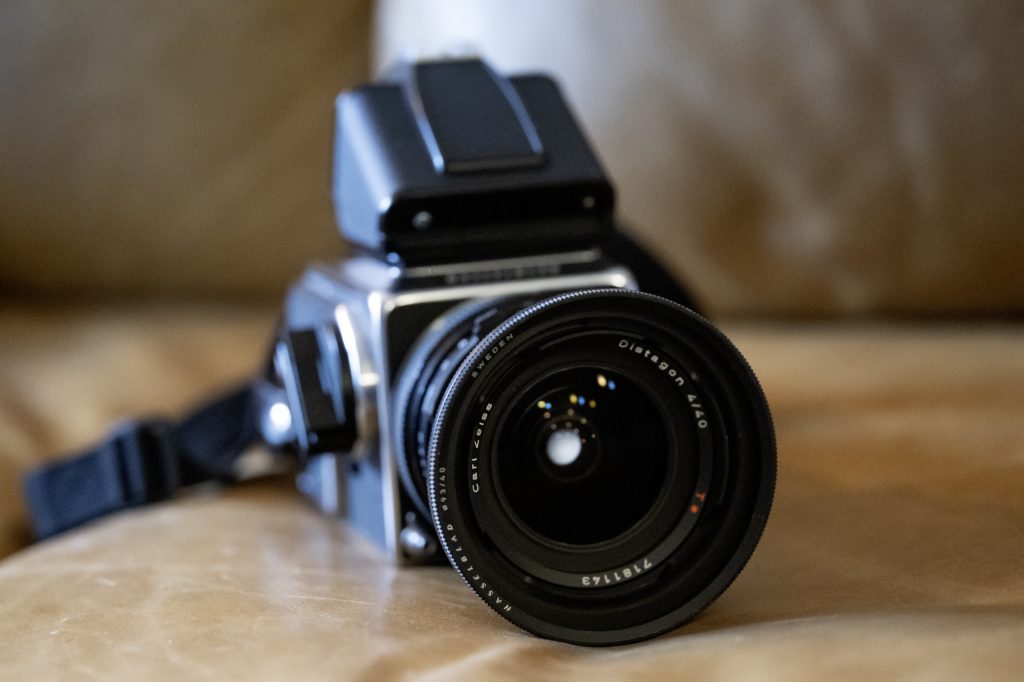
When Hasselblad photographers talk about wide angle lenses for the V system, one name comes up again and again: the 40mm f/4 Distagon T* CF FLE. It is the widest rectilinear lens in the native V-system lineup, and for landscape, architecture, and environmental work, it remains one of the most capable optics ever produced for medium format photography. This is the lens you reach for when 50mm isn’t quite wide enough — and when you want to make a statement with foreground.
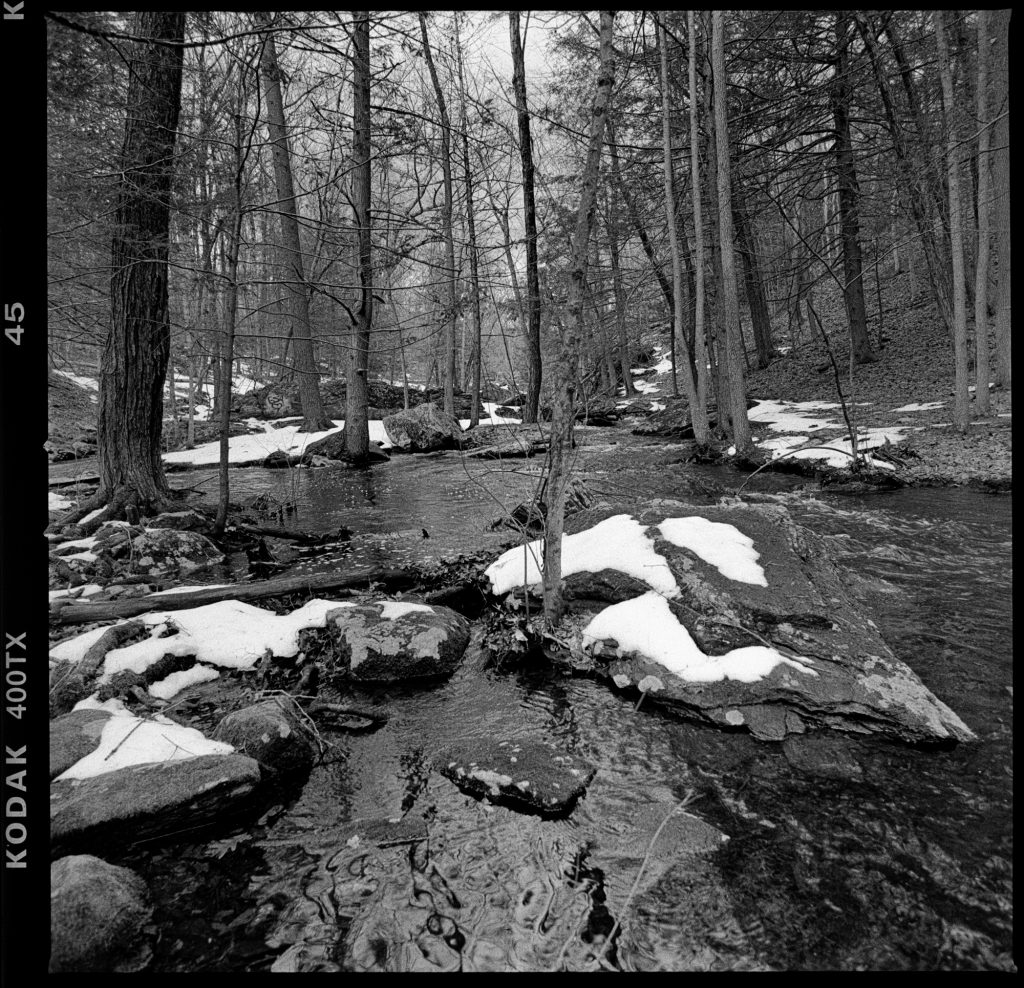
I shot the image above with the CF version on Kodak Tri-X 400, and it’s a good illustration of what this lens does when the conditions are right.
A Brief History of the 40mm in the V System
The 40mm Distagon has gone through several distinct iterations across the decades, each representing an incremental refinement of an already exceptional optical formula.
C 40mm f/4 (1960s–early 1970s)
The original C-series version was the first wide angle option available to Hasselblad 500C shooters, and for its era it was remarkable. Like all C lenses, it featured a Compur leaf shutter integrated into the barrel — a key design feature that allowed flash sync at all shutter speeds. It used a Bay 70 filter mount, which remains consistent across all versions of this focal length. The C version lacked what would later become the lens’s defining feature: the Floating Lens Element (FLE). As a result, edge sharpness and field flatness suffered somewhat at closer focus distances, which is a characteristic limitation of retrofocus wide angle designs at the time. Still, it produced excellent results and established the 40mm as a legitimate creative tool for V-system shooters.
CF 40mm f/4 FLE (1982–2004)
This is the version most photographers are likely to encounter today, and the one I use. The CF designation means it is compatible with both the focal-plane shutter bodies (the 2000/200 series) and the traditional leaf-shutter bodies (the 500 series). The addition of FLE — Floating Lens Element — was the major optical breakthrough. The FLE system mechanically adjusts an internal lens group as you focus closer, compensating for the field curvature and coma that plagued earlier retrofocus designs. The practical result is significantly improved corner sharpness and field flatness across the entire focus range, not just at infinity. This made the CF FLE a genuinely different optical instrument compared to the original C version — not merely an updated cosmetic, but a substantive optical redesign. Carl Zeiss T* multi-coating is standard, delivering the characteristic contrast and color neutrality that defines the Zeiss rendering signature.
CFi 40mm f/4 FLE (2004–2013)
The CFi updated the CF with improved sealing, refined internal mechanics, and enhanced T* coatings. Functionally the optical formula remained close to the CF FLE, but Zeiss improved the anti-reflection coatings to better handle modern high-contrast shooting scenarios. The CFi also features a slightly smoother focus ring and updated barrel aesthetics consistent with the rest of the late CFi lineup. Many photographers consider the CFi the most refined version for pure usability, with the CF and CFi trading blows optically depending on individual copy variation.
CFE 40mm f/4 FLE
The CFE is the CF with an added electronic data bus, allowing full communication with the 200-series bodies for aperture-priority automation and exposure data logging. Optically identical to the CFi, the CFE is primarily of interest to shooters working with the 202FA, 203FE, or 205FCC bodies. For 500-series users, the CF or CFi is the more practical choice and typically commands a lower price on the used market without sacrificing anything optically.
Optical Character and Rendering
Across all versions — but especially from the CF FLE forward — the 40mm Distagon renders with what I would describe as disciplined expressiveness. It is wide without being gimmicky. Distortion is well controlled for a retrofocus design of this angle of view; straight lines stay relatively straight at the edges, which matters enormously for architectural work and any scene with strong horizontal or vertical geometry. Vignetting wide open is present but not excessive, and it clears cleanly by f/8.
Contrast is high but not aggressive. Zeiss T* coating renders shadows with clarity and specular highlights without the harsh micro-contrast that can make some lenses feel clinical. On black and white film — Tri-X in particular — the lens produces a tonal signature that feels full and dimensional rather than flat.
Bokeh at f/4 in the near field is smooth without being the defining characteristic of the image — this is a wide angle, not a portraiture optic, and the rendering at depth is more about atmospheric separation than subject isolation.
The Sample Image: A Winter Creek, Kodak Tri-X 400
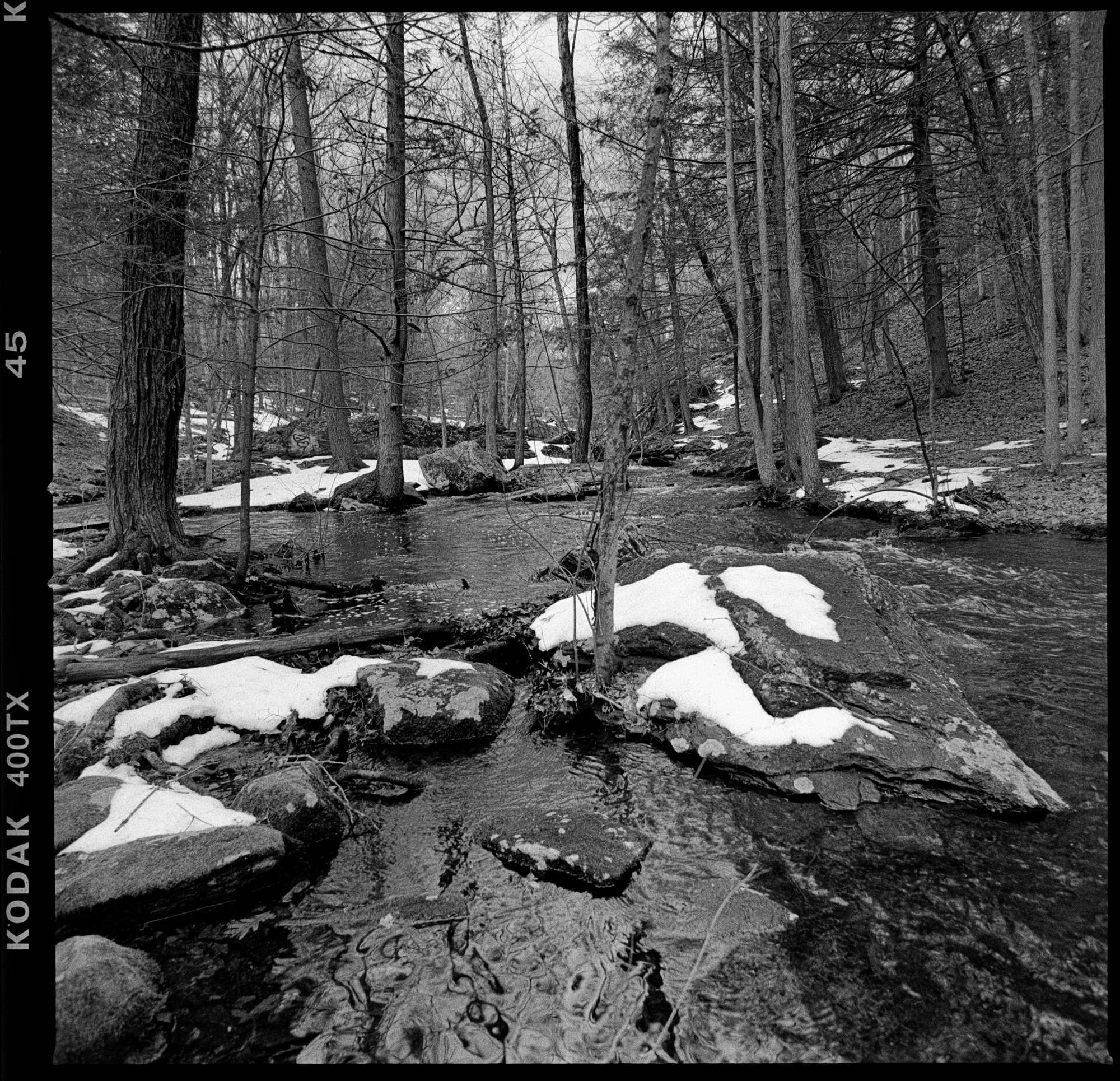
The image above was made on a late winter morning at a small woodland stream — bare trees, snow patches clinging to flat rocks, and dark moving water threading through. Shot on Kodak Tri-X 400 in a Hasselblad 500-series body with the CF 40mm FLE.
What the 40mm does in this scene is something a 50mm simply cannot replicate: it pulls the foreground into the frame with authority. The large flat rocks in the lower third of the image feel genuinely present — you’re not observing the stream from a remove, you’re practically standing in it. The wide angle compression of the near-to-far relationship stretches the visual depth of the scene, so the trees in the background feel appropriately distant while the textured, snow-dusted rocks up front demand attention.
Tri-X is the right film for a scene like this. Its grain structure adds a tactile quality to the rock surfaces that a finer-grained film like FP4 or Acros would render more cleanly but less viscerally. The separation between the white snow patches and the dark wet stone is handled well — the latitude of Tri-X keeps both from blowing out or blocking up entirely. The water reads dark and fast, with just enough surface detail to suggest motion without the blurring of a long exposure.
The square 6×6 format suits the composition. The scene is roughly symmetrical in its energy — water center, rocks flanking, trees dividing the upper half — and the square holds that balance without forcing a crop decision. Shot in portrait orientation on a rectangular format, you’d lose either sky or foreground; in landscape you’d gain width that adds nothing. The square just fits.
This is the kind of image the 40mm was made for: wide but not distorted, close but not oppressively intimate, detailed but not fussy.
Darkroom Notes: Development Process
This roll was processed in-house, which is the only way I’d want to handle Tri-X intended for fine print work.
Developer: Rodinal 1:50 dilution, 11 minutes at 20°C. Rodinal is the opposite of a modern tabular-grain developer — it doesn’t try to suppress grain, it embraces it. At 1:50 it produces the characteristic acutance-forward rendering that Tri-X was practically born for: sharp, defined grain with excellent edge contrast and that unmistakable gritty presence in shadow areas that no digital preset has ever convincingly replicated. The combination of Tri-X and Rodinal is one of the oldest pairings in black and white photography, and it earns its reputation every time. Eleven minutes at 1:50 gives you full shadow detail without pushing the highlights into blockiness — a sweet spot that works particularly well for high-contrast winter scenes where you’re managing both bright snow and dark wet stone in the same frame.
Stop Bath: Eco Pro Stop Bath. Clean, consistent, and effective. It halts development immediately without the harshness of glacial acetic acid stop baths. A brief 30-second agitation bath and you’re ready for fix.
Fixer: Eco Pro Fixer, 4 minutes with periodic agitation. Eco Pro is an odor-reduced rapid fixer that clears Tri-X cleanly in that window without the need for extended time. Properly fixed film is properly fixed — there’s no shortcutting this step, and 4 minutes gives you the confidence to move forward.
Wash and Final Bath: A thorough running water wash followed by a Kodak Photo-Flo bath before hanging to dry. Photo-Flo is one of those chemistry staples that costs almost nothing and eliminates water spots and streaking on the negative surface entirely — on medium format, where a single frame represents real real estate on the light table, it’s not optional.
The negatives from this roll printed with excellent density range — shadow detail in the dark water retained separation, and the snow held texture without blocking up. Rodinal at 1:50 with Tri-X rewards scenes with a wide tonal spread, and this one had exactly that.
Practical Considerations
Filter use is the main mechanical friction point with the 40mm. The Bay 70 mount accepts a center-filter (the CF Center Filter is practically mandatory if you’re shooting color slide film or need critical uniformity across the frame), polarizers, and the standard Hasselblad gelatin filter holder. For black and white work, a yellow or orange filter through the Bay 70 slot is easily managed.
The FLE ring on the CF and later versions is a separate control from the focus ring — you set it to correspond with your focus distance. Some photographers find this a small annoyance in the field; I find it a minor and largely automatic habit after the first few rolls. The optical payoff at closer distances makes it worthwhile without question.
Flare resistance is excellent for a wide angle, though like any lens it will generate contrast loss and ghosting when shooting directly into strong light sources. At f/8–f/11, stopped-down flare is well controlled.
Used pricing as of early 2026 puts clean CF FLE copies in the $700–$950 range depending on condition, with CFi versions running somewhat higher. Given what this lens does, that represents strong value against any modern alternative at equivalent image circle coverage.
Final Thoughts
The 40mm f/4 Distagon T* CF FLE is not a lens you buy because you need something a 50mm can’t provide for most subjects. It’s a lens you buy because you’ve decided foreground matters, because you want the scene to have depth and presence rather than compression and flatness, and because you’re willing to work with a wide angle’s inherent demands in exchange for what it gives you. In the V system, nothing else does what it does. After 30+ years of medium format shooting, it remains one of the most purposeful optics I own.
All images shot with Hasselblad 500cm, 40mm f/4 Distagon T CF FLE on Kodak Tri-X 400.
Purchasing gear from the above link helps me keep the site going!