Category: Developing Medium Format Film
Developing 120 film at home is more accessible than most photographers expect. The chemicals are the same ones used for 35mm, the tanks are only slightly larger, and the process itself — whether black and white or C-41 color — follows the same fundamental steps. The biggest difference is that medium format negatives are less forgiving of sloppy technique. A larger negative means more visible evidence of uneven agitation, temperature swings, water spots, and dust.
That’s where most of the learning happens. Getting a roll through the tank isn’t hard. Getting a roll through the tank with even development, no streaks, and clean negatives takes practice and attention to the details that don’t matter as much with smaller formats.
This page collects everything I’ve written about developing medium format film — from step-by-step processing guides for both black and white and color, to diagnosing common problems like streaking, uneven density, and water spots. If something has gone wrong with one of my rolls, there’s a good chance I’ve written about it here, along with what caused it and how I fixed it.
If you’re just getting started with home development, begin with the process guides and come back to the troubleshooting articles when you inevitably need them.
 Rodinal For Medium Format Development
There are developers that photographers use, and then there are developers that photographers believe in. Rodinal, or Adonal as it’s sometimes branded, belongs in the second category. It is one of the oldest photographic chemicals still in active production — a concentrate so simple, so stable, and so opinionated in its results that it has...
 Wet Mounting Issues with Medium Format
The Case Against Wet Scanning: Why Mounting Fluid Might Not Be Worth the Trouble After years of experimenting with wet-mount scanning, I’ve come to a conclusion that might be controversial in film photography circles: for most of us, anti-Newton ring glass is the better path. Here’s why. The Promise of Wet Scanning If you’ve spent...
 Ilford HP5 Plus — History and Developing Tips
If there’s one black and white film stock that has earned its place in nearly every film photographer’s bag, it’s Ilford HP5 Plus. It’s not the sharpest. It’s not the finest grained. It’s not even the most visually striking at box speed. But HP5 is the film you reach for when you need to get...
 Developing Color Film at Room Temperature
If you have ever talked yourself out of developing color film at home, the reason was almost certainly temperature. The standard C-41 process calls for developer at 102°F, held within a degree or two for the duration of the development step. That requirement sends people shopping for sous vide machines, foot spas, immersion circulators, and...
 Hard Water Spots on Film Negatives: Causes, Prevention, and Fixes
Hard Water Spots on Film Negatives: Causes, Prevention, and Fixes Few things are more deflating than pulling a freshly developed roll of 120 film from the drying line and discovering a constellation of white spots and mineral deposits scattered across your negatives. You nailed the exposure. You got the development right. And now there are...
 Dynamic Range Of Film Scanning
Your film is holding more information than you think. If your scanned negatives look flat, lack shadow detail, or feel like they can’t compete with digital captures, the problem almost certainly isn’t the film — it’s the digitization process. A well-exposed color negative on modern film stock can record 12 to 14 stops of scene...
- Fogged Film From Light Leaks
Film Fogging: How to Identify and Prevent Light Leaks in Your Photographs If you’ve ever pulled a roll of freshly developed film from the tank — or received scans back from your lab — only to find mysterious glows, color shifts, or washed-out areas creeping into your frames, you’ve encountered fogging. It’s one of the...
 Inkjet Vs. Darkroom Prints
This is question I’ve always pondered. I’ll never stop shooting film, but do I need to enlarge in a darkroom as well? Is scanning and printing a better option? A scanned negative can retain the total gradations and colors I get from film, but also gives me a digital master that can’t be lost, scratched,...
 The Cost of Shooting Medium Format Film
Shooting medium format film is one of the most rewarding experiences in photography. The massive negatives, the shallow depth of field, the tonal richness — there’s nothing quite like it. But let’s not sugarcoat it: medium format film is expensive to shoot, and the costs have only gone up in recent years. Whether you’re considering...
 Film Developing Issues
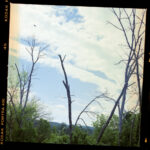
The image below demonstrates several problems that can occur during home development. Dust, fibers, and processing errors are all common hazards. This test shot shows what happens when chemistry goes wrong. There’s also a fiber visible near the center—a reminder that medium format’s larger negatives attract and display more debris. The rest of the roll...
 Streaks in Film
These streaks can be surge marks from overly vigorous agitation, bromide drag, or a combination of the two. Bromide Drag: Diagnosing Vertical Banding in 120 Film Development If you’ve ever pulled a roll of 120 film from your development tank only to find mysterious vertical streaks running through your highlights, you’ve encountered one of the...
- Developing Color Film at Home
I’m currently using the CineStill kit below to develop color medium format film. This kit is easy to use and fairly inexpensive, around $30 and will develop about 8 roles of 120 film. Your results may vary. Temperature is more important when developing color film, lower temps will require increased development times. The instructions are...