
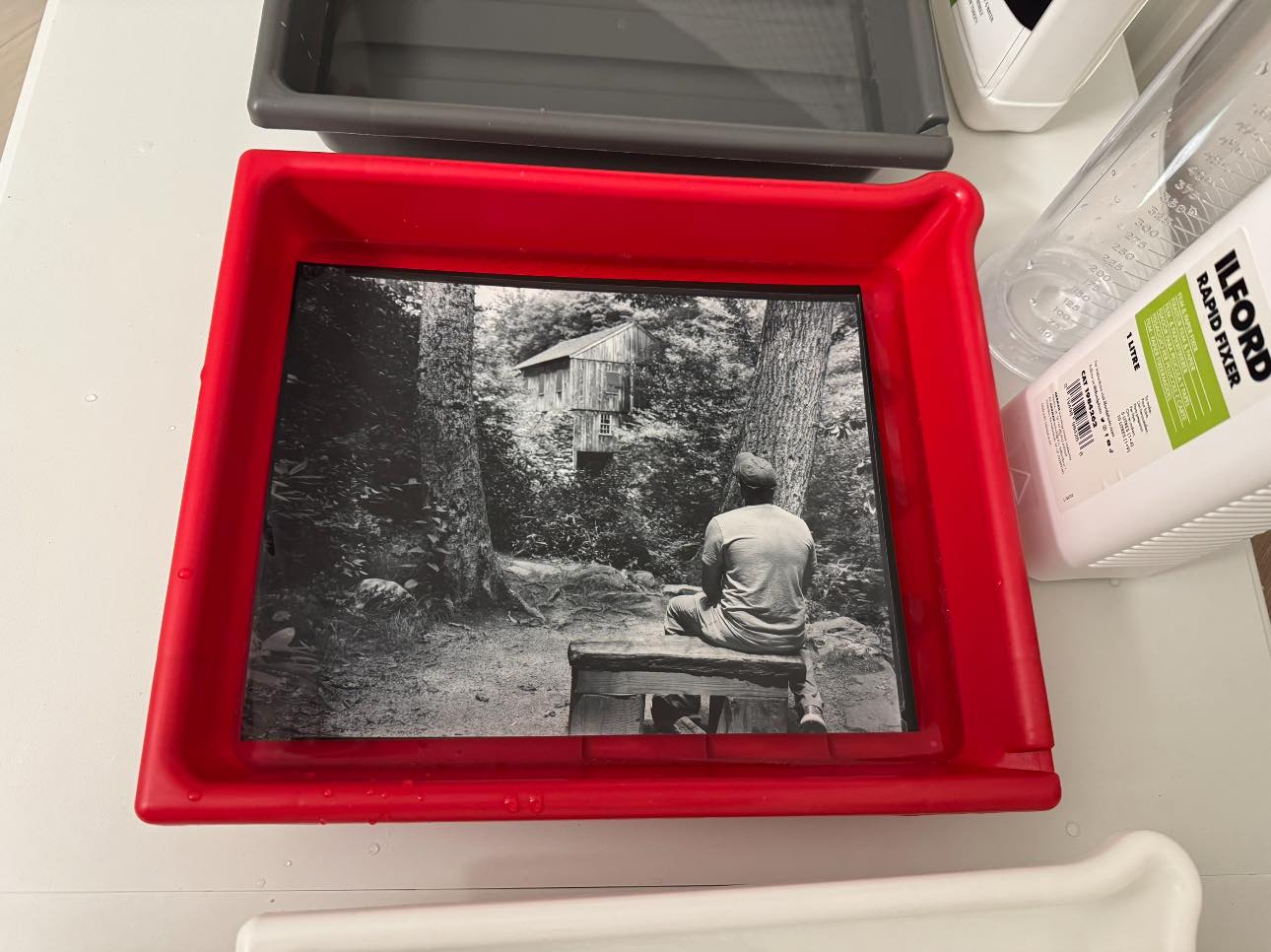
While not medium format, I really enjoy contact printing with my 8×10 view camera. There’s something special about making a direct print without any kind of enlarging, nor scanning process, and the level of detail is astonishing! This is a portrait my wife took of me. I often use the quality of an 8×10 print as my holy grail of what I try to obtain from medium format. While I know it’s not obtainable, it’s something to strive for nonetheless. These contact prints don’t suffer the issues of a scanned medium format negative because there’s no enlarging of dust particles or scratches.
Contact Printing 8×10 Negatives: The Unmatched Beauty of a Dying Art
There’s a reason photographers who’ve experienced a true contact print from a large format negative often describe the moment as revelatory. In an era dominated by inkjet printers and digital workflows, the contact print stands apart—a direct, unmediated translation of silver and light that no digital process can fully replicate.
What Is a Contact Print?
A contact print is exactly what the name suggests: the negative is placed in direct contact with photographic paper and exposed to light. There’s no enlarger, no lens, no optical system between the negative and the final image. The print is the same size as the negative—in the case of 8×10 film, a generous eight by ten inches of continuous tone.
This directness is the source of the contact print’s magic.
The Case for Unmatched Detail
When you enlarge a 35mm negative to 8×10, you’re magnifying it roughly eight times. Even a medium format 6×7 negative requires significant enlargement to reach that size. Each degree of magnification introduces optical limitations—lens aberrations, vibration, alignment issues, and the fundamental constraints of projecting light through glass.
A contact print sidesteps all of this. Every grain of silver in the negative transfers directly to the paper at a 1:1 ratio. The result is a level of sharpness and micro-contrast that even the finest enlarger lenses struggle to match. Fine details—the texture of fabric, individual strands of hair, the bark of a distant tree—emerge with a clarity that feels almost three-dimensional.
Compare this to a high-quality inkjet print. Even the best photo printers, laying down microscopic droplets of pigment at 1440 or 2880 dpi, are building an image from discrete dots. The transitions are smooth to the eye, certainly, but they’re constructed rather than continuous. A silver gelatin contact print has no dots, no pixels, no discrete units. The tonal information exists as a continuous gradation of metallic silver suspended in gelatin—an analog signal in the truest sense.
The Tonal Quality
Beyond sharpness, contact prints from 8×10 negatives possess a tonal richness that digital prints struggle to match. The silver gelatin process produces blacks of extraordinary depth—a quality photographers call “d-max”—that inkjet prints, even on the finest baryta papers, can only approximate. There’s a luminosity to the highlights and a separation in the shadows that gives the image a sense of depth and presence.
Part of this comes from the paper itself. Fiber-based silver gelatin paper has a dimensional quality. The image isn’t sitting on top of the paper; it’s embedded within the emulsion, interacting with light in complex ways. Glossy prints, when dried to a high sheen, have a liquid depth that no inkjet coating has successfully replicated.
The Contemplative Process
Making a contact print is slow work, and this slowness shapes the final result. You load your holders, compose on the ground glass under a dark cloth, meter the scene, calculate your exposure, trip the shutter. Then you develop the negative, assess it on the light table, and only then begin the printing process.
In the darkroom, you make test strips, evaluate them under safe light, adjust your exposure and contrast filtration, and burn and dodge with your hands or simple tools. Each print takes minutes to expose and process, and you might make a dozen attempts before arriving at one that fully realizes your vision for the image.
This extended dialogue between photographer and photograph produces something different than a digital workflow. The decisions are deliberate. The investment of time and materials creates a pressure toward care and intention. The resulting print carries that accumulated attention.
The Honest Disadvantages
None of this comes without significant trade-offs.
Time investment: Where a digital print takes minutes from file to finished output, a contact print from an 8×10 negative represents hours of work. Shooting large format in the field is slow. Developing sheet film requires careful handling. The printing itself demands an unhurried evening in the darkroom. For photographers accustomed to rapid iteration, this pace can feel prohibitive.
The paper curling problem: Fiber-based photographic paper, the material that produces the finest contact prints, has a maddening tendency to curl as it dries. The paper absorbs water during processing, expands, and then contracts unevenly as it releases that moisture. The result is prints that refuse to lie flat, curling toward the emulsion or away from it depending on humidity and drying conditions.
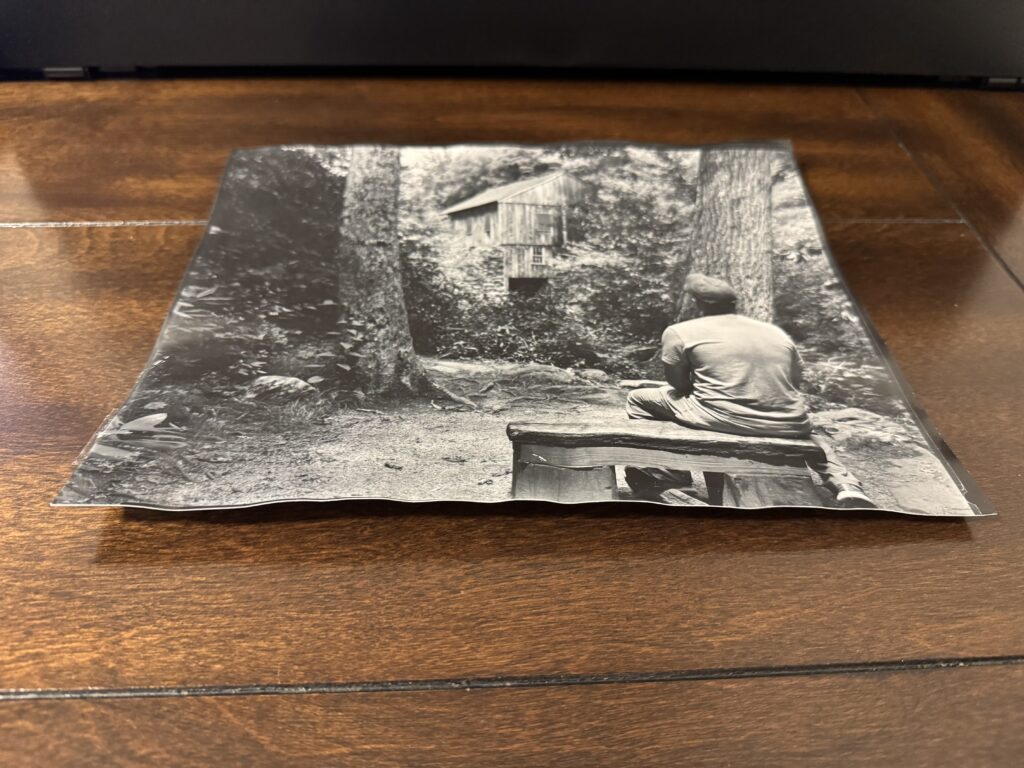
Solutions exist but none are perfect. Dry-mounting permanently bonds the print to a board but alters its character and is irreversible. Flattening in a heated press helps but the curl often returns over time, especially in humid environments. Some printers accept the curl and frame under glass, which holds the print flat but adds reflection and distance between viewer and image.
Material costs: Large format film isn’t cheap, and it’s getting more expensive as production scales down. Silver gelatin paper has followed the same trajectory. Each 8×10 sheet of quality fiber paper represents a meaningful investment, which raises the stakes on every print.
The learning curve: Contact printing is straightforward in concept but demands developed skills in practice. Evaluating negatives, managing contrast, mastering the timing and agitation of multiple chemical baths—these abilities take time to acquire. Early prints will likely disappoint.
Archival concerns: Properly processed silver gelatin prints can last centuries, but “properly processed” is doing a lot of work in that sentence. Incomplete washing leaves residual fixer in the paper, which eventually stains and degrades the image. Selenium or gold toning adds permanence but requires additional chemistry and handling.
Is It Worth It?
For photographers who value the physical object, who find meaning in craft and process, and who want to produce prints with qualities unavailable through any other means—yes, contact printing 8×10 negatives remains deeply worthwhile.
The resulting print has a presence that digital output struggles to match. It’s not just an image of something; it’s a physical artifact with its own material reality. The silver catching light, the paper with its specific weight and tooth, the knowledge that this object came into being through an extended process of attention and care.
This doesn’t make contact prints “better” than digital in any absolute sense. The immediacy and flexibility of digital printing serves many purposes beautifully. But for those willing to accept the time, cost, and physical challenges, the 8×10 contact print offers something genuinely different—a direct connection between the light that entered the camera and the image that hangs on the wall.
Some photographs deserve that connection.
Browse large format gear at KEH.com
Purchasing gear from the above link helps me keep the site going!